OSHA aerial lift certification requirements call for employer-led training and evaluation of each operator under 29 CFR 1926.453 (construction) or 1910.67 (general industry), not a federal exam or card. This distinction surprises many employers who assume a national license exists. In reality, the employer must pick a qualified trainer, deliver classroom and hands-on instruction, and document that every operator has shown competence. Falling short carries real financial risk, since OSHA can issue serious violation penalties that reached roughly $16,550 per violation in recent enforcement cycles, with willful or repeat violations climbing above $165,000.
Understanding this framework matters because many workers assume that completing an online course alone satisfies OSHA aerial lift certification requirements, when in fact the regulation demands a combination of instruction, a practical skills evaluation, and employer sign-off.
Key Takeaways
- OSHA has no national aerial lift certification program; employers must train and evaluate operators under 29 CFR 1926.453 (construction) and 1910.67 (general industry).
- Training must include classroom instruction, a hands-on skills evaluation, and documented proof that the operator can identify hazards specific to the equipment used.
- Retraining is required whenever an operator is observed operating unsafely, is involved in a near miss, changes lift type, or the workplace changes conditions, even without a fixed expiration date.
- Most employers follow the ANSI A92.24 recommendation of a three-year refresher cycle even though OSHA itself does not mandate an interval.
- Online course fees typically range from $25 to $75, while in-person courses with a practical evaluation run $150 to $350 per operator.
- Serious OSHA violations for untrained aerial lift operators can result in penalties near $16,550, with willful violations exceeding $165,000.
What OSHA Actually Requires Instead of a National Card
Federal regulation 29 CFR 1926.453 governs aerial lifts on construction sites, while 1910.67 applies to general industry settings such as warehouses and manufacturing facilities. Neither standard references a certification card, a registry, or a testing body approved by the federal government. Instead, OSHA places the burden on the employer to designate a “qualified person,” defined as someone with the knowledge, training, and experience to recognize hazards associated with aerial lift operation.
This qualified person must train each operator on the specific make and model of lift used at the worksite, since a scissor lift and a telescoping boom lift present different tip-over risks, load limits, and control layouts. Many private training providers use the phrase “OSHA certified” in marketing materials, but this language refers to a course built to satisfy OSHA’s training content requirements, not a government-issued credential. Employers should treat any course as a starting point for compliance rather than a guaranteed legal shield if an operator is later found untrained on the actual equipment in use.
Who Must Complete Aerial Lift Training
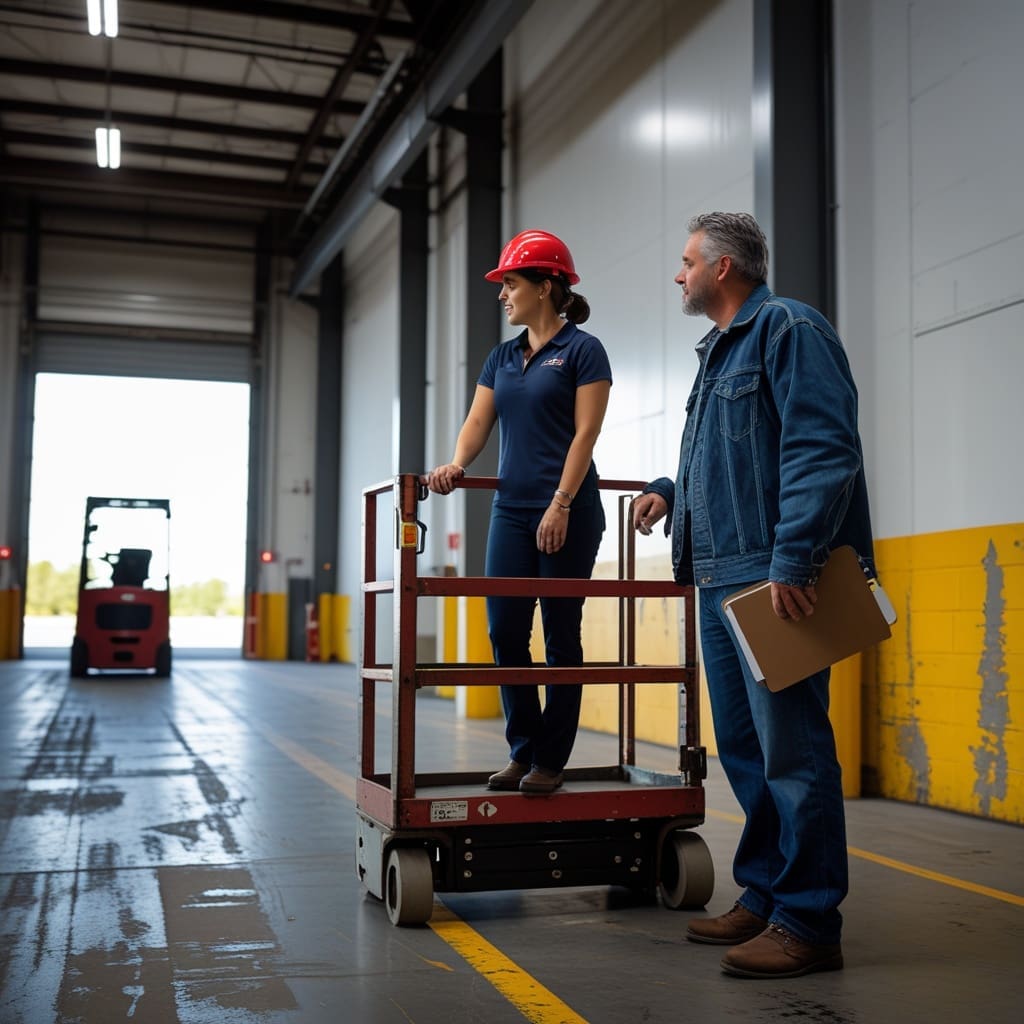
Any employee who operates a boom lift, scissor lift, vertical mast lift, or similar mobile elevating work platform must complete training before working unsupervised. This obligation extends beyond construction crews to include warehouse staff performing high-shelf picking, maintenance technicians servicing overhead equipment, electricians, painters, sign installers, and arborists working from bucket trucks. Supervisors who occasionally step onto a platform to inspect work are not exempt simply because operation is infrequent. Temporary and seasonal workers fall under the same rule. A staffing agency employee assigned to a warehouse for two weeks needs the same documented instruction as a full-time hire, and the host employer shares responsibility for confirming that training happened before the worker touches the controls.
Employers in industries with frequent lift use, such as commercial construction and warehousing, typically train a large share of their workforce, while smaller contractors may designate only two or three certified operators per crew. Regardless of company size, OSHA’s general duty clause and the specific training provisions in 1926.21(b)(2) require documented instruction before assignment, not after an incident occurs. Rental companies that supply lifts often ask for proof of training before releasing equipment, and some job sites bar untrained workers from the area entirely, even as spotters or ground guides.
Core Training Content Every Course Must Cover
A compliant training course follows a structured sequence that mirrors the hazards operators will actually face on the job. Most reputable programs organize instruction into four practical stages:
- Introduction to aerial and scissor lift safety, covering statistics on tip-over and fall incidents, OSHA citation history, and the legal basis for training under 29 CFR 1926.453.
- Equipment types and classifications, distinguishing between Group A (vertical only, such as scissor lifts) and Group B (articulating or telescoping boom lifts) under ANSI A92.20.
- Pre-use inspection procedures, requiring operators to check hydraulic lines, tires, guardrails, and emergency lowering controls using a documented checklist before every shift.
- Safe operating procedures during use, including load capacity limits, wind speed thresholds (commonly capped at 28 miles per hour for outdoor boom lifts), fall protection anchor points, and safe distances from overhead power lines, typically a minimum of 10 feet under OSHA’s minimum approach distance rule.
Course length varies by provider, but most online modules take three to five hours to complete, followed by a hands-on evaluation that adds 30 to 45 minutes per lift type the operator must demonstrate competence on.
Testing and Practical Evaluation Standards
A written knowledge test typically requires a minimum passing score of 80 percent, and most providers allow one or two retakes at no additional charge within a 30-day window. Passing the written portion alone does not satisfy OSHA aerial lift certification requirements, since the standard explicitly calls for a practical evaluation on the actual equipment the operator will use.
During the hands-on evaluation, the qualified trainer observes the operator performing a pre-use inspection, positioning the lift correctly, maneuvering around obstacles, and executing an emergency descent. Operators who fail the practical portion usually receive additional coaching and a second attempt within the same session, since sending an untrained worker back to the floor creates immediate liability exposure for the employer.
An operator who passes a written exam but has never touched the actual controls of the lift model assigned to them does not meet OSHA’s training standard, regardless of any certificate issued.

Certification Costs and Renewal Timelines
Pricing depends heavily on delivery format and the number of lift categories covered. A rough breakdown for 2026 pricing looks like this:
- Online-only training: $25 to $75 per operator, covering classroom content but requiring the employer to conduct the hands-on evaluation separately.
- Bundled online plus employer-led practical evaluation: $50 to $120 per operator, including printable evaluation checklists.
- Full in-person course with trainer-led practical testing: $150 to $350 per operator, often including a physical wallet card or digital badge upon completion.
- Group or fleet training for 10 or more operators: $1,200 to $3,000 total, which often reduces the per-person cost to under $100.
OSHA itself sets no expiration date on training, but the ANSI A92.24 standard recommends a three-year refresher cycle, and most insurance carriers and general contractors now require proof of training renewal within that window before allowing subcontractor operators on site. Retraining is also mandatory, regardless of how recently a card was issued, whenever an operator is observed operating a lift unsafely, is involved in an accident or near miss, is assigned to a new lift type, or when workplace conditions change in a way that affects safe operation.
Employer Responsibilities and Recordkeeping
Employers must maintain training records that identify the operator by name, the date of training, the trainer’s qualifications, and the specific lift model evaluated. OSHA inspectors frequently request these records during a site visit, and missing documentation can result in a citation even if the operator was, in practice, competent. Records should be retained for the duration of employment plus a reasonable buffer, commonly three years, to align with the industry refresher cycle.
Employers also carry responsibility for daily equipment inspection logs, since 1926.453(b)(2)(i) requires that lifts be inspected before each shift regardless of when the operator last completed formal training. Failing to document either the training or the daily inspection creates two separate exposure points during an OSHA audit, and inspectors typically treat each missing record as a distinct violation rather than a single combined issue.
If your business cannot produce a signed training record within minutes of an OSHA inspector’s request, treat that gap as an immediate compliance risk, not a paperwork inconvenience.
Businesses that manage multiple job sites or a rotating workforce should consider a digital tracking system that flags upcoming refresher deadlines automatically. Schedule your next round of aerial lift training now rather than waiting for a near miss or an inspection to force the issue, since the cost of proactive training remains far lower than a single serious citation.

Conclusion
Meeting OSHA aerial lift certification requirements comes down to three consistent practices: selecting a qualified trainer, documenting both classroom and hands-on evaluation for the exact equipment used, and refreshing that training on a predictable schedule even though federal law sets no fixed expiration date. Employers who treat training as an ongoing safety program rather than a one-time checkbox tend to avoid both citations and preventable injuries. Building this discipline into daily operations protects workers and reduces the financial exposure tied to serious or willful OSHA violations.
Consider what actually happens when a company skips these steps. A warehouse operator gets a quick verbal walkthrough on a scissor lift, never touches a boom lift, then gets assigned to a boom lift job the following month. If an inspector shows up after an incident and asks for training records specific to that boom lift, there’s nothing to show. That gap alone can turn a routine inspection into a serious violation, with fines that reached over $16,000 per violation as of 2024, and willful or repeat violations climbing past $161,000. The cost of proper training is small next to that exposure.
A workable compliance routine usually includes these elements:
- A trainer with real qualifications. This means someone with documented knowledge of aerial lift hazards, ANSI standards, and the specific equipment models used on site, not just a supervisor reading a slideshow out loud.
- Equipment-specific hands-on evaluation. A worker certified on a scissor lift is not automatically qualified for a boom lift or a telehandler. Each class of equipment needs its own evaluation.
- Written records that hold up under audit. Names, dates, trainer credentials, equipment used, and evaluation results should be kept on file and easy to pull up if OSHA asks.
- Retraining triggers. Retraining isn’t optional when a worker is seen operating unsafely, gets assigned new equipment, is involved in a near-miss, or when workplace conditions change (new surface types, added overhead hazards, different load requirements).
- A refresher schedule. Many employers use a three-year cycle as a baseline, mirroring OSHA’s forklift training model, even though aerial lifts don’t have that exact rule written into the standard.
Small and mid-size contractors often assume certification is a one-and-done task handled during onboarding. That assumption is what leads to gaps. A worker trained two years ago on an older lift model may not know the load chart or stability limits on a newer machine the company just rented. Treating each new piece of equipment, each new job site, and each observed unsafe habit as a possible retraining moment closes that gap before an inspector or an injury forces the issue.
Ultimately, the employers who stay out of trouble aren’t the ones who memorize every line of 29 CFR 1926.453. They’re the ones who build a simple, repeatable process: qualified trainer, equipment-specific evaluation, solid records, and a retraining schedule that doesn’t wait for a near-miss to kick in. That process costs far less than a citation, and it’s the difference between a worker going home safe and becoming a statistic in an OSHA incident report.
Frequently Asked Questions
Does OSHA issue an official aerial lift certification card?
No, OSHA does not issue any certification card or national credential. The agency requires employers to train and evaluate operators under 29 CFR 1926.453 and 1910.67, and any card received from a training provider reflects that company’s internal documentation, not a government-issued license.
How long does aerial lift certification training take to complete?
Most operators finish classroom instruction in three to five hours, plus one to two additional hours for the hands-on evaluation. Total time depends on how many lift categories, such as scissor lifts and boom lifts, the operator needs to demonstrate competence on.
How often must aerial lift training be renewed?
OSHA sets no fixed renewal interval, but most employers follow the ANSI A92.24 recommendation of every three years. Retraining is also required immediately after any unsafe operation, accident, near miss, or change in lift type, regardless of the three-year schedule.
What score is needed to pass the aerial lift certification exam?
Most training providers require a minimum score of 80 percent on the written knowledge test. A passing written score alone is not sufficient, since operators must also pass a hands-on practical evaluation on the specific lift model they will use.
What happens if an employer allows an untrained operator to use an aerial lift?
The employer can face a serious OSHA violation with penalties around $16,550, or over $165,000 for willful violations. Beyond financial penalties, untrained operation significantly raises the risk of tip-over incidents, falls, and contact with overhead power lines, which remain among the leading causes of aerial lift fatalities.