
A straddle carrier is a self-propelled, rubber-tired machine that drives directly over a shipping container or lumber load, lifts it between its own legs, and hauls it to a new spot in one continuous motion. Unlike a crane, which stays fixed to a track, boom, or foundation and swings loads within a set radius, a straddle carrier combines lifting and horizontal transport in a single vehicle. Port terminals and lumber yards favor this design because it removes the need for a separate truck or chassis to move a container once it has been picked up. Most container-handling straddle carriers lift between 40 and 50 metric tons and can stack boxes three to four high, according to Kalmar’s terminal equipment specifications, making them a workhorse for high-volume yard operations.
Key Takeaways
- A straddle carrier straddles a container or load, lifts it off the ground, and drives it to a new position, doing the job of a crane and a hauling vehicle at once.
- Standard container straddle carriers handle 40 to 50 metric tons and stand roughly 40 to 50 feet tall, depending on stacking height.
- Cranes suit fixed-point, high-elevation lifts, while straddle carriers suit horizontal moves across an open paved yard.
- Operator training for straddle carriers commonly runs 40 to 80 hours of combined classroom and hands-on instruction, separate from NCCCO crane operator certification tracks.
- According to the American Association of Port Authorities, terminals using straddle carrier operations report roughly 20 to 30 percent shorter container dwell time compared with chassis-based systems.
What Is a Straddle Carrier, Exactly?
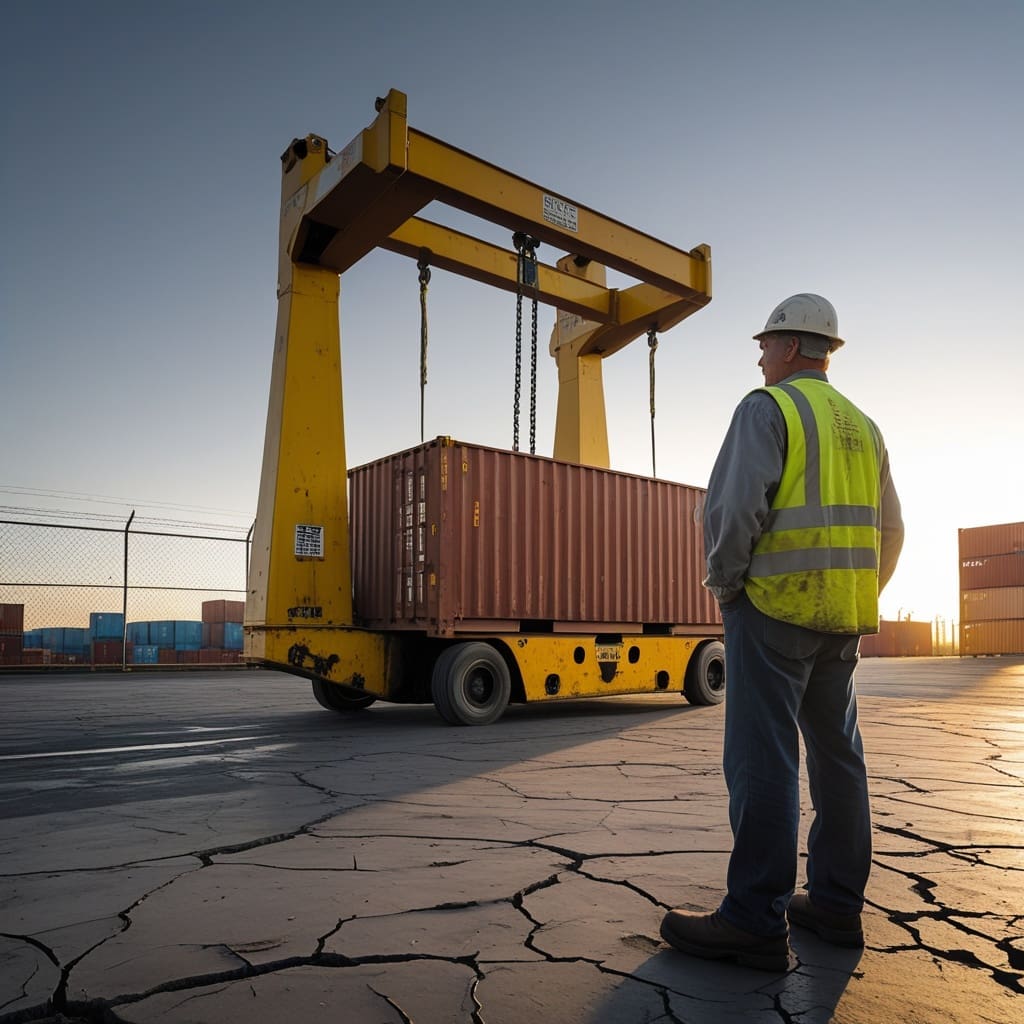
A straddle carrier is a tall, rubber-tired vehicle with a rigid steel frame built to straddle a container or a stack of lumber, lower a lifting mechanism onto it, and carry it between the legs to a new location. The design dates back to the 1950s, when lumber operations needed a way to move long boards without a crane or forklift damaging them in the process. Today you will find these machines most often at container terminals, intermodal rail yards, and large-scale lumber mills.
The core difference from a crane is mechanical, not just operational. A crane lifts a load straight up and swings it within a fixed arc. A straddle carrier physically rolls over the top of the load, clamps or spreads onto it, raises it off the ground, and then drives it on its own wheels to the destination. That means no track, no boom, and no anchored base. The machine moves freely across any paved surface, which gives yard operators far more flexibility when cargo needs to be repositioned frequently across a wide footprint.
Most modern container carriers use a telescopic spreader, a rectangular frame fitted with twist-locks that engage the corner castings on a standard shipping container. That spreader extends and contracts to fit 20-foot, 40-foot, and 45-foot boxes on the same machine. Some newer combi models swap the spreader for a different attachment entirely, letting a single carrier handle bundled lumber, steel coils, or other non-containerized freight without a full equipment change.
How a Straddle Carrier Actually Works
The operator sits in a cab mounted high on the frame, often 30 feet or more off the ground, which gives a clear line of sight straight down into the container stack. A single lift-and-move cycle follows a fairly consistent sequence:
- Positioning (30 to 60 seconds): The operator drives the carrier so its legs align directly over the target container.
- Lowering the spreader (10 to 20 seconds): A telescopic hoist mechanism drops the spreader frame down onto the container’s top corner castings.
- Locking (5 to 10 seconds): Twist-locks rotate into the corner castings, securing the container to the spreader.
- Lifting (15 to 30 seconds): A hydraulic or chain-driven hoist raises the container clear of the ground or the stack below it.
- Transport (1 to 3 minutes): The carrier drives to its new location, whether that is another stack, a rail car, or a waiting truck chassis.
- Setdown (15 to 30 seconds): The operator lowers the container into place and releases the twist-locks.
A full cycle for one container typically runs between 3 and 6 minutes, based on operational benchmarks published by the Port of Long Beach. A terminal running a fleet of 15 to 25 straddle carriers can push through well over 1,000 individual container lifts per shift when yard traffic and stacking patterns are managed efficiently. That throughput is the main reason ports keep investing in these machines rather than relying solely on chassis-and-truck combinations.
Straddle Carrier vs. Crane: Which One Fits the Job?
The choice between a crane and a straddle carrier usually comes down to three factors: how far the load needs to travel, how high it needs to be lifted, and how much site infrastructure already exists.
- Mobility: Straddle carriers drive themselves across open pavement. Cranes, aside from mobile crane models, stay fixed to a track, chassis, or foundation.
- Lift height: Straddle carriers max out near 50 feet. Gantry and tower cranes can exceed 200 feet, making cranes the clear choice for tall structural or shipbuilding work.
- Load capacity: A standard straddle carrier handles 40 to 50 metric tons. Heavy-duty cranes, such as shipyard goliath cranes, lift 500 to 1,200 tons or more.
- Site preparation: A straddle carrier only needs a flat, paved surface. A fixed crane requires substantial foundation work and structural installation before it can operate.
- Cycle speed: A straddle carrier lifts and transports a load in a single 3-to-6-minute cycle. A crane usually needs a separate truck to carry the load once it is set down, which adds time to every move.
Most large container terminals run both types of equipment side by side rather than choosing one over the other. Ship-to-shore gantry cranes handle the vertical lift of containers off the vessel, and straddle carriers then take over for the horizontal trip from the dock to the storage stack. Each machine does the part of the job it is best suited for, and the combination keeps cargo moving without bottlenecks at either end of the yard.
Where Straddle Carriers Are Put to Work
Container terminals remain the most visible setting for straddle carrier operations, but the equipment shows up in several other heavy-freight environments as well.
Port terminals use straddle carriers to move containers between the quay, the storage yard, and the gate where trucks pick up outbound freight. Because the carrier eliminates the wait for a chassis-and-tractor pairing, terminals report faster turnaround on inbound and outbound moves. The American Association of Port Authorities has noted that ports relying on straddle carrier fleets, rather than chassis-only systems, cut container dwell time by roughly 20 to 30 percent, a meaningful gain when a single vessel call can involve thousands of container moves in a 24-hour window.
Intermodal rail yards use the same basic equipment to transfer containers between rail cars and truck chassis or storage stacks, since the carrier’s height and reach let it work directly over rail lines without needing a dedicated overhead structure. Lumber yards and sawmills use a modified version fitted with hydraulic clamps instead of a spreader, since raw lumber bundles do not have the corner castings a twist-lock spreader depends on. Some heavy-industry yards handling steel coils, pipe, or oversized machinery components also lean on combi-style carriers built to swap attachments depending on the cargo of the day.
Types of Straddle Carriers You Will Encounter
Straddle carriers are not a one-size-fits-all category. The following types cover most of what you will see in active service today.
Container straddle carriers are the machines most people picture at a port. They run telescopic spreaders that adjust to 20-, 40-, and 45-foot container lengths, stack boxes three to four high, and travel at speeds up to 20 miles per hour across a paved yard.
Lumber straddle carriers trade the spreader for hydraulic clamps or forks, since bundled boards have no corner castings to lock onto. Sawmills use these to shuttle stacked lumber from the mill floor to storage yards and onto outbound rail cars or flatbed trucks.
Combi straddle carriers are built for operations that handle a mix of cargo types. A single machine can switch between a container spreader and a clamp attachment, which cuts equipment costs for yards that do not run high enough volume of any one cargo type to justify a dedicated fleet for each.
Automated and semi-automated straddle carriers use GPS positioning, laser guidance, and centralized yard-management software to move containers with minimal or no operator input inside the cab. Major terminals in Rotterdam and Hamburg have run automated straddle carrier fleets for years, and several U.S. West Coast terminals have piloted similar systems as part of broader automation investments through 2026.
Operator Certification and Training Requirements
Straddle carrier operation falls outside the scope of standard NCCCO crane certification, since OSHA’s crane standard at 29 CFR 1926.1400 covers cranes and derricks, not self-propelled straddle equipment. That does not mean training is optional. Employers still carry a general duty obligation under the OSH Act to provide equipment-specific instruction before anyone operates heavy yard machinery of this size and weight class.
In practice, most terminal and lumber yard operators require 40 to 80 hours of combined classroom and hands-on training before a new operator runs a straddle carrier solo. That training typically covers spreader operation and twist-lock procedures, stacking limits and stability under load, pedestrian and traffic awareness in a busy yard, and emergency shutdown procedures specific to the manufacturer’s model, whether that is a Kalmar, Konecranes, or Combilift unit.
Straddle carrier training and crane operator training are not interchangeable, even though both involve lifting heavy loads in industrial settings.
The skill sets do overlap in places, particularly around load charts, rigging awareness, and site communication protocols, which is why many training providers structure their programs to show how training differs for operators running these specialized container-handling machines compared with standard mobile crane work. A crane operator spends most of their training on boom angle, load radius, and swing control. A straddle carrier operator spends more time on spreader alignment, stacking stability, and navigating a yard shared with trucks, pedestrians, and other carriers moving at the same time.
Ongoing inspection matters just as much as initial certification. Twist-locks, hoist chains, hydraulic clamps, and tire wear all need regular checks, since a failure at 30 feet up with a 40-ton container attached carries real consequences. Yard managers typically schedule daily pre-shift checks alongside more thorough periodic inspections that mirror the kind of equipment checks yard and terminal machinery like this needs to stay compliant and safe over years of heavy daily use.
Frequently Asked Questions
How much does a straddle carrier cost?
A new container straddle carrier typically costs between $1.5 million and $2.5 million, depending on lift capacity and whether it runs diesel-electric or fully electric drive. Used units in good working condition sell for roughly $400,000 to $900,000, according to pricing patterns reported across major terminal equipment resellers in 2026. Lumber carriers with simpler clamp attachments generally cost less than full container-spec models.
How much weight can a straddle carrier lift?
Most container straddle carriers lift between 40 and 50 metric tons. Heavier-duty models built for oversized or non-standard loads can exceed that range, but standard port terminal units stay within the 40-to-50-ton window across most major manufacturers.
Do you need a special certification to operate a straddle carrier?
Yes, though the certification path differs from crane operator certification and generally involves 40 to 80 hours of employer-provided or manufacturer-specific training. There is no single national standard equivalent to NCCCO for straddle carriers, so requirements vary by employer, terminal operator, and state.
What is the difference between a straddle carrier and a reach stacker?
A straddle carrier drives over the top of a container and lifts it between its legs, while a reach stacker lifts a container from the side using a front-mounted boom and spreader. Straddle carriers generally handle higher stacking and faster cycle times in dedicated container yards, while reach stackers offer more flexibility in tighter or mixed-use spaces.
How fast can a straddle carrier move a container across a yard?
A straddle carrier typically completes one full lift-and-move cycle in 3 to 6 minutes, including positioning, lifting, transport, and setdown. Travel speed across a paved yard can reach up to 20 miles per hour, though actual speed drops when carrying a loaded container for safety reasons.
Conclusion
A straddle carrier earns its place in a port terminal or lumber yard by doing two jobs at once: lifting a heavy load and hauling it across open ground without a second vehicle. That combination shortens cycle times, cuts container dwell time by a meaningful margin, and gives yard operators flexibility that a fixed crane simply cannot match. Choosing between a crane and a straddle carrier comes down to distance, height, and how the site is already built out, and most large terminals end up using both for different parts of the same operation. If your team is weighing new equipment or preparing operators for certification on machinery like this, Certified Safety Experts can help you sort out the right training path for the specific equipment your yard runs.