
A boom truck is a commercial truck fitted with a hydraulic lifting arm, called a boom, mounted directly on its chassis to lift, position, or move heavy materials. Unlike a standalone crane that arrives on a dedicated carrier, a boom truck combines transport and lifting capability into a single vehicle. This makes it one of the most practical pieces of equipment in construction, utility work, and material delivery, since one truck can haul a load to a site and then lift it into place without a second machine.
Boom trucks range from small service vehicles with a 3-ton lifting capacity to heavy-duty units capable of hoisting loads over 40 tons. The boom itself may telescope, articulate at multiple joints, or do both, depending on the job it is built for. Because the lifting mechanism is bolted to a road-legal truck frame, boom trucks are regulated as cranes under federal safety rules once they exceed a 2,000-pound rated capacity, which shapes how operators are trained and certified.
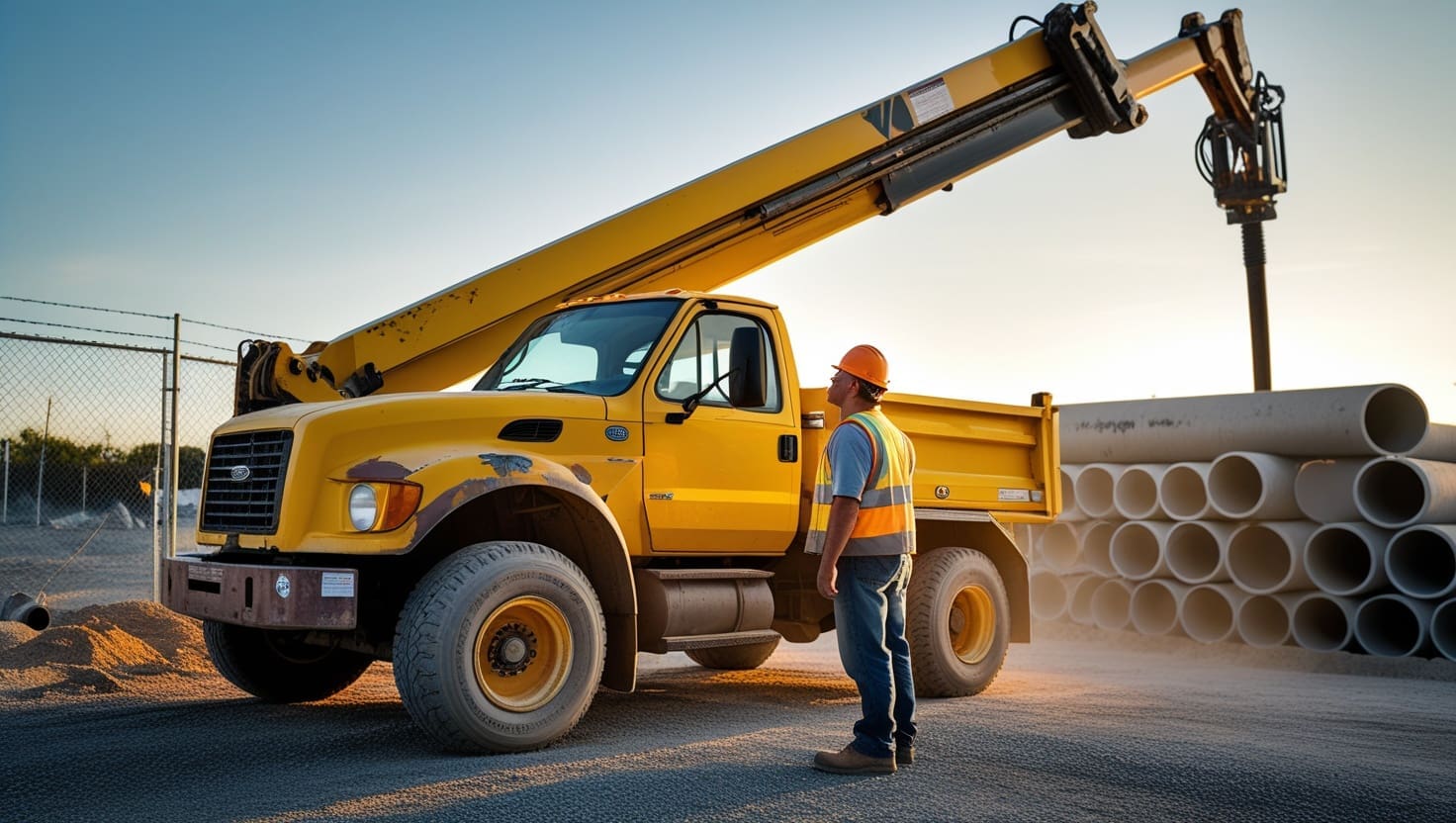
Key Takeaways
- A boom truck is a truck-mounted hydraulic crane built into the vehicle chassis, combining transport and lifting into one unit.
- Common types include telescopic boom trucks, articulating (knuckleboom) boom trucks, digger derricks, and utility service boom trucks.
- Lifting capacities typically range from 3 to 40 tons, with boom reach spanning roughly 30 to over 200 feet depending on the design.
- Boom trucks with a rated capacity above 2,000 pounds fall under OSHA’s crane regulations in 29 CFR 1926 Subpart CC.
- The main difference from a traditional crane is mobility and setup speed. A boom truck drives to the site and lifts almost immediately, while a crane often needs a separate carrier and assembly time.
- Operators lifting more than incidental loads generally need certification through a body such as NCCCO, plus employer-verified training specific to the boom type.
How a Boom Truck Is Built and How It Works
A boom truck starts with a standard commercial truck chassis, often a medium or heavy-duty frame rated for 26,000 to 80,000 pounds gross vehicle weight, depending on the boom size it will carry. Manufacturers reinforce the frame with subframes and outriggers to handle the side loads and tipping forces that come from lifting. The boom itself sits behind the cab or over the rear axle, powered by a hydraulic system that draws from the truck’s engine through a power take-off unit.
The boom extends, retracts, and rotates through hydraulic cylinders controlled from a cab-mounted panel or a remote pendant. Outriggers deploy from the frame to widen the truck’s footprint before any lift begins, since a narrow wheelbase alone cannot resist the tipping moment created by a load swung out at full reach. Rigging, meaning the slings, hooks, shackles, and other hardware that connect the load to the boom, determines how safely and precisely a load can be set. Poor rigging choices, not the truck itself, cause a large share of boom truck incidents on job sites.
Types of Boom Trucks
Boom trucks are built around a handful of core designs, each suited to different industries and load profiles. Understanding these types matters because the boom style, not just the truck size, determines where and how the equipment can be used.
- Telescopic boom trucks: These use a boom made of nested sections that slide in and out hydraulically, reaching straight-line distances of 30 to 150 feet. They are common for delivering and setting building materials such as trusses, HVAC units, and precast panels.
- Articulating boom trucks (knuckleboom trucks): These have two or more hinged sections that fold like an elbow, letting the boom reach over obstacles and set loads at odd angles. Capacities commonly range from 5 to 50 tons, with some heavy models exceeding that, and reach can extend past 200 feet on the largest units.
- Digger derricks: Built primarily for utility companies, these combine a boom with an auger attachment for digging holes and setting utility poles. They typically handle 4,000 to 12,000 foot-pounds of lifting capacity and are a fixture in electrical and telecom line work.
- Service and utility boom trucks: Smaller units, often rated under 5 tons, used for signage installation, tree work, and general maintenance where a full-size crane is unnecessary.
Among these, articulating boom trucks have become especially popular for tight urban sites because the folding boom design can maneuver around power lines, buildings, and other obstructions that would block a straight telescopic reach. That flexibility is exactly why demand for trained articulating boom operators has grown faster than for other boom categories in recent years.
Boom Truck vs. Crane: What Is the Real Difference?
A boom truck mounts its lifting arm on a standard truck chassis, while a traditional crane, such as a rough terrain or all-terrain crane, is built on a purpose-designed carrier meant primarily for lifting rather than highway travel. This distinction affects speed, setup, and cost in ways that matter for project planning.
Boom trucks can drive on public roads at highway speeds and typically require only 10 to 20 minutes to set up outriggers and begin lifting. A comparable mobile crane, by contrast, may need 45 minutes to over an hour to rig for a lift, and some larger lattice-boom crawler cranes require a separate transport truck and several hours of assembly on site.
Capacity is another point of separation. While a boom truck typically tops out around 40 to 50 tons, dedicated mobile cranes routinely handle 75 to 300 tons or more, and specialized crawler cranes can exceed 1,000 tons for heavy industrial lifts. In practical terms, a boom truck fills the gap between a forklift and a full mobile crane, ideal for jobs that need frequent repositioning and moderate capacity rather than a single massive lift.
A useful rule of thumb: if the load needs to be delivered and lifted in the same trip, a boom truck usually gets the job done faster. If the load exceeds 40 tons or the reach exceeds what a truck-mounted boom can offer, a dedicated crane becomes necessary.
Common Uses and Industries That Rely on Boom Trucks
Boom trucks show up across a wide range of commercial and industrial settings because they solve the same basic problem: getting a heavy item from the ground to an elevated or hard-to-reach spot without a separate crane rental. Rigging companies frequently deploy them for jobs that fall between what a forklift can handle and what a full mobile crane is needed for.
- Construction: Setting roof trusses, HVAC rooftop units, precast concrete sections, and structural steel components on mid-size commercial buildings.
- Utilities and telecom: Placing utility poles, transformers, and overhead line equipment, often using the digger derrick variant.
- Oil and gas: Moving wellhead equipment, pipe sections, and modular skids at remote sites where a full crane crew is impractical.
- Data centers and industrial facilities: Rigging air handling units, generators, and server racks into position during retrofits or new builds.
- Sign and lighting installation: Setting highway signage, billboards, and stadium lighting fixtures using smaller service boom trucks.
Because the truck itself handles both transport and lifting, contractors often save on equipment rental costs compared to bringing in a separate delivery truck and a standalone crane. A single articulating boom truck can frequently replace two pieces of equipment on smaller jobs, which is part of why rental fleets have expanded this category faster than traditional crane inventory over the past several years.
Boom Truck Operator Training and Certification
Operating a boom truck rated above 2,000 pounds capacity falls under federal crane safety rules, specifically 29 CFR 1926 Subpart CC, which the Occupational Safety and Health Administration finalized to cover cranes and derricks used in construction. Under this standard, operators generally need to be certified by an accredited testing organization or qualified through an employer audit program that meets the same criteria.
The National Commission for the Certification of Crane Operators, known as NCCCO, offers a dedicated Articulating Boom Crane certification alongside its broader Mobile Crane Operator credentials. Candidates typically complete a Core written exam plus a specialty exam matched to the boom type they operate, followed by a hands-on practical exam demonstrating control, rigging judgment, and load handling. Certification is valid for five years, after which operators must recertify to keep their credentials current.
Written exam fees through NCCCO generally run in the $75 to $100 range per exam module, while practical exams, which require access to actual equipment and a qualified examiner, typically cost between $250 and $450 depending on the test site and boom class. Employers often cover these costs as part of onboarding for new operators, since uncertified personnel operating regulated equipment can expose a company to OSHA citations and liability.
For readers responsible for training staff or scheduling certification, a dedicated articulating boom crane certification program walks operators through the specific exam content, practical skill requirements, and renewal timeline tied to this boom category. Choosing the right certification path matters more than picking any general crane course, since the skills for a telescopic boom differ meaningfully from those needed on a multi-joint articulating arm.
Safety Practices Every Boom Truck Site Should Follow
Boom truck safety depends on a short list of practices that apply regardless of boom type or capacity. Ignoring any one of them is a leading cause of tip-overs, dropped loads, and contact incidents with overhead power lines.
- Confirm ground conditions before setup. Outriggers need firm, level support; soft or sloped ground can shift a fully loaded truck past its tipping point within seconds.
- Check the load chart for the exact boom angle and extension. Capacity drops sharply as reach increases, often by 50 percent or more between minimum and maximum extension.
- Maintain minimum clearance from power lines. OSHA generally requires at least 10 feet of clearance from lines up to 50kV, with greater distances required for higher voltages.
- Inspect rigging hardware before every lift. Slings, shackles, and hooks should be checked for wear, cracks, or deformation each shift, not just during scheduled inspections.
- Use a signal person or spotter for blind lifts. Any lift where the operator cannot see the landing zone directly should include a dedicated signal person using standard hand signals or radio communication.
These steps are not exhaustive, but they cover the failure points that show up most often in incident reports involving truck-mounted cranes. A five-minute pre-lift check is a small price compared to the cost of a dropped load or a tipped truck.
Call to Action
If your team operates or plans to operate an articulating boom truck, do not wait for an OSHA inspection to find out your certifications are out of date. Review your current operator credentials against the five-year NCCCO renewal window, confirm your rigging crew has current training, and reach out to schedule an articulating boom crane certification course before your next major lift.
Conclusion
A boom truck earns its place on job sites by combining transport and lifting into one machine, saving time and money compared to bringing in separate delivery and crane equipment. Whether the job calls for a telescopic boom setting rooftop units or an articulating boom threading a load between power lines, the right truck and a properly certified operator make the difference between a smooth lift and a costly incident. Matching the boom type to the job, and keeping certification current, remains the most reliable way to get consistent results from this equipment.
Frequently Asked Questions
What is the difference between a boom truck and a bucket truck?
A boom truck is built for lifting loads, while a bucket truck is built to lift a worker in an enclosed platform. Bucket trucks use a boom-like arm too, but the end fitting is a personnel basket rather than a hook or rigging point, and they follow a different set of OSHA rules focused on personnel lifting.
How much weight can a boom truck lift?
Most boom trucks lift between 3 and 40 tons, though some heavy articulating models exceed that. The exact capacity at any given moment depends on boom angle and extension length, since capacity drops as the load moves farther from the truck.
Do you need a special license to drive a boom truck?
Yes, in most cases a Commercial Driver’s License is required to drive the truck on public roads, and a separate crane operator certification is required to operate the boom. The CDL class depends on the truck’s gross vehicle weight rating, while the certification depends on the boom type under NCCCO or an equivalent accredited body.
What industries use boom trucks the most?
Construction, utility line work, oil and gas, and telecommunications rely on boom trucks most heavily. These industries need frequent, moderate-capacity lifts combined with the ability to relocate quickly between job sites, which plays directly to a boom truck’s strengths.
How long does it take to become a certified boom truck operator?
Most candidates complete certification within 4 to 8 weeks, including training, written exams, and a practical skills test. Timelines vary based on prior experience and how quickly a candidate can schedule the practical exam at an accredited test site, but the certification itself remains valid for five years once earned.