
Telehandler safety training teaches operators how to inspect, operate, and maneuver a telescopic handler safely, and OSHA requires it because telehandlers fall under its powered industrial truck certification rules. The training pairs classroom or online instruction with a hands-on skills test run by a qualified trainer. Employers aren't just being careful when they require it: OSHA holds them directly responsible for whether an operator is actually competent. One uncertified operator who causes a tip-over or dropped load can bring citations costing tens of thousands of dollars per violation, not counting what an injury or death on site would cost.
Key Takeaways
- Telehandler safety training is legally required under 29 CFR 1910.178(l) and 29 CFR 1926.1400, which classify telehandlers as powered industrial trucks.
- Training must include formal instruction, a hands-on evaluation, and periodic refreshers, typically every three years or sooner after an incident.
- Costs generally run between $75 and $400 per operator, depending on whether the course is online, in-person, or bundled with a practical skills test.
- OSHA does not issue certification cards directly; employers or their designated trainers are responsible for evaluating and certifying each operator.
- ANSI/ITSDF B56.6 sets the design and operating standard that most training curricula are built around for rough-terrain telehandlers.
What Does Telehandler Safety Training Actually Cover?
Telehandler safety training covers machine stability principles, load charts, pre-shift inspection procedures, and safe operating practices on uneven or sloped terrain. Because a telehandler’s center of gravity shifts constantly as the boom extends and lifts, operators must learn to read the load capacity chart mounted in the cab before raising or extending any load. A load that is safe at a low boom angle can exceed the rated capacity the moment the boom extends outward, and this single misunderstanding causes a large share of tip-over incidents reported to OSHA each year.
A typical curriculum includes the following components, each tied to a specific skill the operator must demonstrate:
- Pre-operation inspection (15-20 minutes per session): Operators check tire condition, hydraulic lines, boom pins, outriggers, and backup alarms before every shift.
- Load chart interpretation (30-45 minutes of instruction): Operators practice reading capacity charts at varying boom angles and extensions using sample scenarios.
- Stability and tip-over prevention (45-60 minutes): Instruction covers the stability triangle, ground conditions, and how attachments change rated capacity.
- Hands-on operating evaluation (1-3 hours): A qualified evaluator observes the trainee performing lifts, travel with a load, and placement tasks on an actual or simulated telehandler.
- Site-specific hazard review (20-30 minutes): Training addresses hazards unique to the employer’s location, such as overhead lines, soft ground, or pedestrian traffic.
Most complete programs, combining the classroom portion with the hands-on evaluation, take between four and eight hours to finish for a new operator. Experienced operators transferring certification from another employer or renewing after three years often complete a condensed refresher in two to three hours.
What Are the OSHA Requirements for Telehandler Operators?
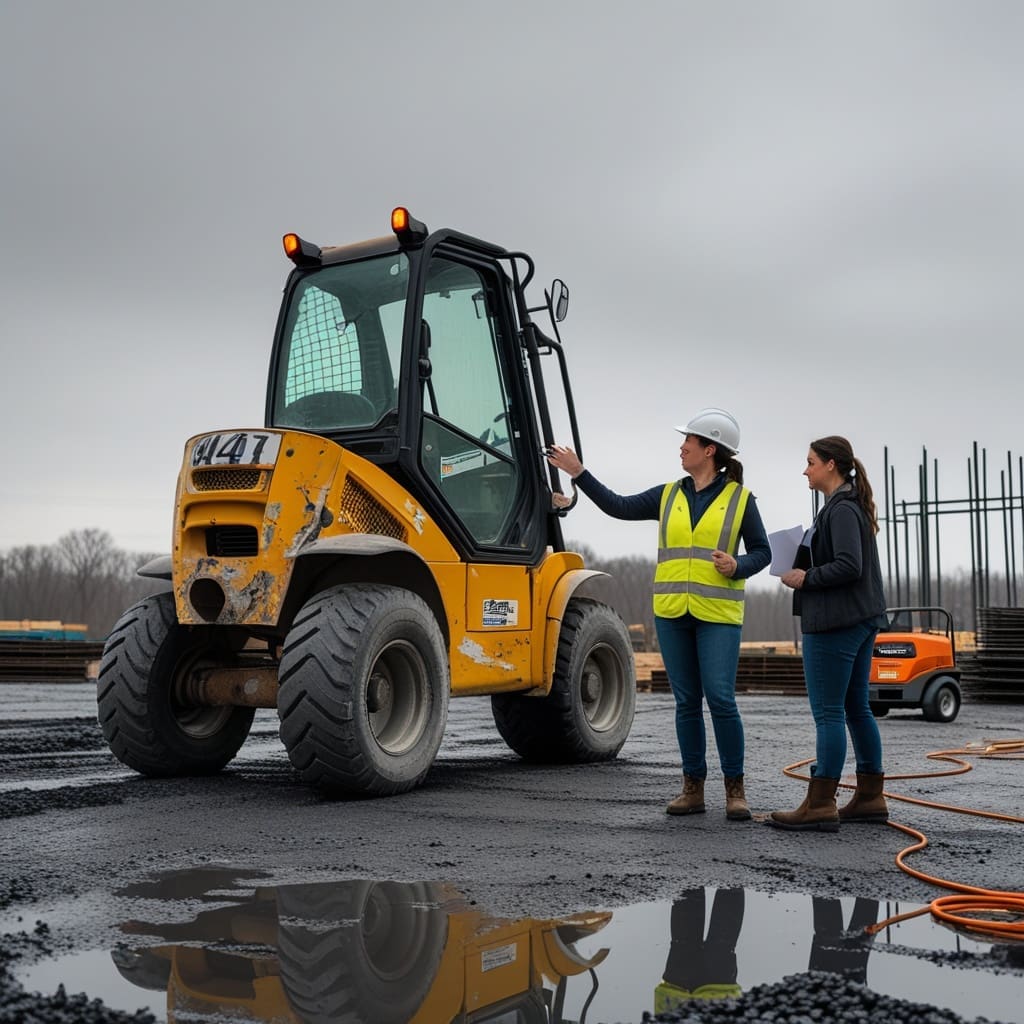
OSHA requires every telehandler operator to be trained and evaluated before operating the machine unsupervised, under standards found in 29 CFR 1910.178(l) for general industry and 29 CFR 1926.1400 through 1926.1442 for construction sites. These regulations classify telehandlers as powered industrial trucks, the same broad category that covers warehouse forklifts and rough-terrain lift equipment, which is how this overlaps with standard powered industrial truck credentialing.
The regulation requires three distinct phases for every operator: formal instruction (lecture, video, or written material), practical training (demonstrations and exercises under the trainer’s supervision), and an evaluation of the operator’s performance in the actual workplace. OSHA does not accept classroom instruction alone as sufficient, and it does not recognize a certificate from any training provider as automatically valid without the employer confirming the hands-on evaluation took place. Understanding where telehandler operation fits within federal powered industrial truck rules helps employers see why a generic forklift card does not substitute for telehandler-specific evaluation.
Refresher training is mandatory under 29 CFR 1910.178(l)(4) in several specific situations:
- The operator has been observed operating the vehicle in an unsafe manner.
- The operator has been involved in an accident or near-miss incident.
- The operator receives an evaluation indicating they are not operating the equipment safely.
- The operator is assigned to a different type of truck or attachment they have not previously used.
- A condition in the workplace changes in a way that could affect safe operation, such as new ground surfaces or layout changes.
Absent any of these triggers, OSHA requires a full re-evaluation of each operator at least once every three years. Many employers schedule this on the operator’s hire-date anniversary to keep records consistent across a workforce.
Telehandler Forklift Certification vs. General Safety Training: What Is the Difference?
Telehandler forklift certification is the formal credential an operator receives after completing training and passing a hands-on evaluation, while safety training is the instructional process that leads to that credential. The two terms get used interchangeably in casual conversation, but they describe different stages of the same requirement. Training is the education; certification is the employer’s documented confirmation that the training was completed and the operator demonstrated competence.
This distinction matters because OSHA inspectors ask for documentation, not just a claim that training occurred. A certification record should include the operator’s name, the date of training, the name of the person who conducted the training and evaluation, and the specific type of equipment covered. Employers who skip the documentation step, even after genuinely training their staff, can still face citations for failing to prove it under 29 CFR 1910.178(l)(6).
How Much Does Telehandler Safety Training Cost?
Telehandler safety training typically costs between $75 and $400 per operator, depending on the format and whether the hands-on evaluation is bundled into the price. Online-only theory courses, which cover regulations, load charts, and inspection procedures, generally run $75 to $150 per person and take two to four hours to complete. These online modules satisfy the formal instruction portion of OSHA’s requirement but never satisfy the hands-on evaluation requirement by themselves.
In-person training that includes both classroom instruction and a practical evaluation on an actual telehandler generally costs $150 to $400 per operator, according to pricing data compiled by the National Association of Safety Professionals. Group rates for employers training five or more operators at once often bring the per-person cost down by 15 to 25 percent, since the trainer’s time and equipment access get spread across more participants. Train-the-trainer programs, which allow a company to certify its own in-house evaluators rather than hiring an outside trainer repeatedly, typically cost between $500 and $900 but pay for themselves after training roughly four or five operators internally.
Renewal training, since it is shorter than initial certification, usually costs less, often in the $75 to $200 range. Employers budgeting for a crew of ten telehandler operators should expect first-year costs somewhere between $1,500 and $4,000 when combining initial certification, site-specific orientation, and any trainer fees, with renewal years costing noticeably less once the program is established.
What Happens If an Employer Skips Telehandler Training?
Skipping required telehandler training exposes an employer to OSHA citations, increased liability in the event of an accident, and higher insurance premiums tied to a poor safety record. OSHA classifies failure to train powered industrial truck operators as a serious violation, and penalties for serious violations reached $16,550 per violation in 2026, with willful or repeated violations climbing as high as $165,514 per instance. A company with multiple untrained operators across a job site can accumulate these penalties quickly if an inspector reviews records during a routine visit or after an incident.
Beyond regulatory penalties, the safety stakes are significant. According to data cited by the National Institute for Occupational Safety and Health, tip-overs and falls from telehandlers and similar rough-terrain equipment remain among the leading causes of serious construction equipment injuries each year, with many incidents traced back to operators who lacked formal evaluation on the specific machine involved. The Bureau of Labor Statistics has also noted that transportation incidents, which include equipment rollovers, consistently rank among the top causes of fatal occupational injuries in the construction sector.
Insurance carriers increasingly ask for documented training records when underwriting construction and industrial policies. A contractor who cannot produce certification records for telehandler operators may see liability premiums rise 10 to 20 percent at renewal, or face outright denial of claims tied to equipment the carrier determines was run by an uncertified operator. This single gap in paperwork can undo years of an otherwise clean safety record.
Who Is Qualified to Conduct Telehandler Training?
A qualified trainer must have the knowledge, training, and experience to both operate a telehandler safely and train others to do the same, a standard OSHA leaves intentionally broad to accommodate different workplace structures. This can be an experienced in-house supervisor who has completed a train-the-trainer program, a third-party safety consultant, or an equipment manufacturer’s representative. What OSHA does require is that the trainer be able to demonstrate both operating competence and the ability to evaluate another person’s performance against established safety criteria.
Employers should document the trainer’s qualifications just as carefully as the operator’s, since what employers check to confirm a telehandler operator meets the standard often becomes the first thing an OSHA inspector or insurance auditor reviews after an incident. A trainer’s credentials typically include a record of their own certification, any manufacturer-specific training completed, and documented hands-on experience operating the equipment model being trained on.
Telehandler Operator Training Requirements by Industry
Telehandler operator training requirements shift slightly depending on whether the equipment is used in construction, general industry, or agriculture, though the core OSHA framework applies across all three. Construction sites fall under 29 CFR 1926.1427, which specifically addresses operator training for equipment covered by the broader crane and derrick standard when a telehandler is configured with a personnel platform or hook attachment. General industry settings, such as manufacturing yards or distribution centers using telehandlers for material handling, fall under 29 CFR 1910.178.
Agricultural operations are generally exempt from the formal OSHA powered industrial truck training standard, though many states and insurance carriers still require documented training as a condition of coverage. The table below outlines how requirements commonly differ by setting.
- Construction sites: Formal training plus hands-on evaluation required; additional certification needed if the telehandler lifts personnel in a platform.
- General industry/warehousing: Standard powered industrial truck training under 1910.178(l), with refresher every three years.
- Agriculture: Not federally mandated under OSHA in most cases, but commonly required by equipment insurers and state farm safety programs.
- Government/municipal projects: Often require training documentation to exceed OSHA minimums, sometimes mandating annual rather than triennial refreshers.
How Do You Choose a Telehandler Training Program?
Choosing a telehandler training program comes down to confirming that it covers both the formal instruction and hands-on evaluation OSHA requires, not just an online quiz. Ask any prospective provider whether the course includes a practical skills assessment on an actual telehandler, since a purely video-based course cannot legally stand alone as complete certification. A reputable provider will also issue documentation listing the specific equipment class covered, since a certification for a standard rough-terrain telehandler does not automatically extend to a unit with a specialized attachment like a personnel platform or concrete bucket.
Compare programs on these points before enrolling a crew:
- Does the course include a hands-on evaluation, or only online modules?
- Is the trainer able to provide documented qualifications upon request?
- Does the certificate specify the telehandler make and model class used for training?
- What is the total time commitment, typically four to eight hours for new operators?
- Is refresher training included or discounted for the three-year renewal cycle?
Take the Next Step Toward a Compliant Telehandler Program
Review your current operator records against the three-part OSHA requirement, formal instruction, hands-on evaluation, and documented certification, to confirm every telehandler operator on your site is covered. If gaps exist, schedule training before the next job site audit or insurance review rather than after an incident forces the issue.
Frequently Asked Questions
How long does telehandler safety training take to complete?
Most initial training programs take between four and eight hours, including both classroom instruction and the hands-on evaluation. Renewal or refresher courses for experienced operators usually take two to three hours since they focus on reviewing changes rather than teaching material from scratch.
Does telehandler certification expire?
Yes, OSHA requires a full re-evaluation of each operator at least every three years. Certification can also expire early if the operator is involved in an accident, observed operating unsafely, or switches to a different type of telehandler or attachment.
Can telehandler training be completed entirely online?
No, online coursework can only cover the formal instruction portion, not the required hands-on evaluation. OSHA requires that a qualified trainer observe the operator performing actual lifts and maneuvers on the equipment before certification is considered complete.
Is a forklift certification the same as a telehandler certification?
No, a standard forklift certification does not automatically qualify someone to operate a telehandler. While both fall under the powered industrial truck category, telehandlers have different stability characteristics, boom controls, and load chart behavior that require equipment-specific evaluation.
Who pays for telehandler safety training, the employer or the employee?
Employers are generally responsible for the cost of required safety training under OSHA guidance. Since the training is a condition of employment tied to job duties, most employers cover the full cost, including any trainer fees or time spent during paid work hours.
Conclusion
Telehandler safety training exists because the equipment’s shifting center of gravity and extending boom create hazards that generic equipment experience does not prepare an operator to handle. Employers require it not as a formality but as a direct response to OSHA’s legal standards, the real cost of citations, and the far higher cost of a workplace injury. Building a training program around formal instruction, documented hands-on evaluation, and a consistent three-year renewal cycle keeps both operators and employers protected, and it turns a regulatory obligation into a genuine safety advantage on every job site.