Telehandler certification is documented proof, required under OSHA’s powered industrial truck rules, that an operator has completed formal training and passed a hands-on evaluation on a telescopic handler. It is not a single government-issued license but a combination of classroom instruction, a written test, and a practical skills check performed on the actual machine an employee will operate. According to the National Institute for Occupational Safety and Health, powered industrial trucks, including telehandlers, are linked to tens of thousands of workplace injuries annually, which is precisely why federal regulators require documented training before anyone touches the controls unsupervised. If you work in construction, agriculture, or industrial logistics and expect to run one of these machines, this credential is not optional paperwork. It is a legal requirement with real consequences for both you and your employer if it is missing.
Key Takeaways
- Telehandler certification is required under OSHA’s powered industrial truck standard, 29 CFR 1910.178, and applies to construction sites through 29 CFR 1926.602(c). General industry sites (warehouses, manufacturing plants, agricultural operations) fall under the same core rule, even though the equipment gets used differently in each setting.
- A complete training program includes formal instruction, hands-on practice, and a supervised evaluation on the specific make and model the operator will use. Attachments matter too. An operator trained on a forked telehandler still needs additional evaluation before running a unit fitted with a man basket, winch, or bucket attachment.
- Online course fees typically run $75 to $150, with in-person practical evaluations adding another $150 to $300, bringing most complete programs to roughly $250 to $450.
- OSHA’s operator evaluation cycle requires re-testing at least every three years, though some third-party credentials, such as those issued by the National Commission for the Certification of Crane Operators (NCCCO), remain valid for five years.
- A telehandler card is not interchangeable with a standard forklift card, since OSHA and the ANSI/ITSDF B56.6 consensus standard treat rough-terrain telescopic handlers as a distinct equipment class. The extended reach, boom articulation, and shifting center of gravity create hazards a standard forklift course never addresses.
- Employers, not individual workers, carry the legal duty to verify and document that every telehandler operator holds a current, valid evaluation. Falling short can mean OSHA citations, higher workers’ comp premiums, and liability exposure if an untrained operator causes a jobsite injury.
What Telehandler Certification Actually Covers
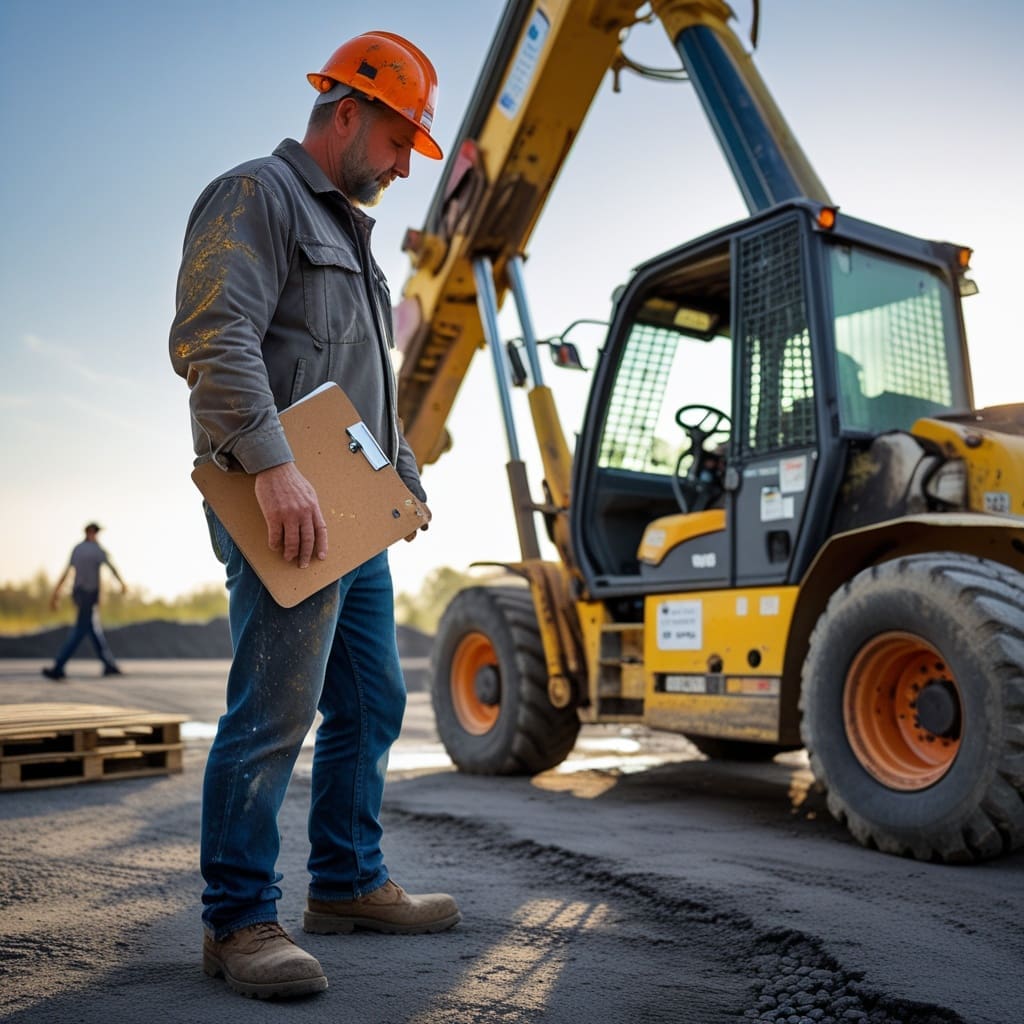
A telehandler, sometimes called a telescopic handler or reach forklift, extends a boom outward and upward rather than lifting a load straight up along a fixed mast the way a conventional forklift does. That extending boom changes the machine’s center of gravity constantly as the load moves, which creates a tip-over risk that does not exist in the same way with a standard sit-down forklift. Certification training addresses this directly by covering load charts specific to boom angle and extension, outrigger deployment on rough terrain, and stability limits under varying ground conditions.
The what evaluators look for to confirm an operator is properly qualified standard applies here as well, since a valid certification depends on demonstrating specific, observable skills rather than simply sitting through a lecture. Evaluators watch for correct load chart interpretation, proper outrigger use before lifting, safe travel speed with an elevated or extended load, and awareness of overhead hazards such as power lines, which become a bigger concern given a telehandler’s extended reach. Training also typically covers attachment changes, since telehandlers frequently swap between forks, buckets, and man-baskets, and OSHA treats each attachment change as something that may require its own evaluation.
OSHA Requirements for Telehandler Operators
OSHA does not issue a single national telehandler license; instead, it requires employers to certify that each operator has been properly trained and evaluated. The governing rule is 29 CFR 1910.178, the general industry standard for powered industrial trucks, and its training provisions extend to construction jobsites through 29 CFR 1926.602(c). Telehandlers used in rough-terrain material handling are also commonly evaluated against the ANSI/ITSDF B56.6 consensus standard, which industry trainers use to define expected competency benchmarks even though it is not itself an OSHA regulation.
Under these rules, a compliant training program must include three distinct components:
- Formal instruction, delivered through a classroom session, online module, or written handout covering vehicle operation, load handling, and workplace-specific hazards.
- Hands-on training, where the trainee practices actual operation under the direct supervision of a qualified person before working independently.
- Performance evaluation, where a qualified evaluator observes the operator using the equipment in the actual work environment and confirms competency in writing.
Employers must document the evaluation, including the operator’s name, the evaluation date, and the specific type of equipment covered. For a full breakdown of the specific OSHA powered industrial truck standards this certification is based on, it is worth reviewing the underlying regulatory text directly rather than relying on a trainer’s summary, since inspectors reference the exact citation language during compliance checks.
OSHA’s rule places the legal burden squarely on the employer, not the worker, to confirm and document that every telehandler operator has a current, site-specific evaluation on file.
Who Actually Needs Telehandler Certification
Anyone who operates a telehandler, even on an occasional basis, needs a documented evaluation before working without direct supervision. This requirement reaches further than most companies initially assume. Common roles that require certification include:
- Construction workers moving lumber, roofing materials, or masonry to elevated levels of a structure.
- Agricultural workers handling hay bales, feed, or stacked pallets on farms and ranches.
- Warehouse and logistics staff operating rough-terrain telehandlers in outdoor storage yards.
- Rental yard and equipment dealership staff who demonstrate machines for prospective customers.
- Supervisors and site safety leads who evaluate operator competency, even if they rarely operate the machine themselves.
Certification earned at a previous employer does not automatically transfer to a new job site. OSHA’s rule requires the current employer to verify competency on the specific equipment in use at that location, which means a worker with years of experience elsewhere may still need a fresh evaluation before running an unfamiliar model. Small business owners are frequently caught off guard by this, assuming a card from a prior job covers them indefinitely. It does not, and an OSHA inspector reviewing training logs will flag the gap immediately.
Telehandler Certification vs. Forklift Certification
A standard forklift card does not automatically qualify someone to operate a telehandler, because the two machines behave differently under load. A sit-down counterbalance forklift lifts a load vertically along a fixed mast, which keeps the center of gravity fairly predictable throughout the lift. A telehandler extends its boom outward and upward at variable angles, and that changing geometry means tip-over risk shifts constantly with load weight, boom angle, and ground surface.
The practical differences show up clearly once you compare the two training paths:
- Equipment covered: Forklift certification applies to counterbalance and reach trucks used mainly indoors; telehandler certification applies to telescopic boom machines built for outdoor, rough-terrain work.
- Stability focus: Forklift training emphasizes fixed-mast lift capacity and aisle maneuvering; telehandler training emphasizes variable-reach load charts and outrigger-based stability.
- Work environment: Forklifts dominate warehouses and indoor distribution centers; telehandlers are standard on construction sites, farms, and rough-terrain outdoor jobs.
- Attachments: Telehandlers frequently switch between forks, buckets, and man-baskets, and OSHA guidance treats certain attachment changes as requiring their own evaluation.
- Cross-training: An operator holding a forklift card must still complete a telehandler-specific evaluation before running one, since OSHA classifies them as distinct powered industrial truck types.
If your crew already carries forklift credentials, do not assume that clears them to run a telehandler on your next project. Reviewing how this compares to standard forklift credentialing requirements makes the distinction clear before you schedule anyone on rough-terrain equipment. Inspectors specifically check whether a worker’s training paperwork names the exact equipment type in use, and a mismatch here is one of the more common citations issued during site audits.
How Much Does Telehandler Certification Cost?
Total cost depends on whether you complete training online, in person, or through a bundled program that combines both. Based on typical pricing across accredited safety training providers, here is a realistic cost breakdown:
- Online classroom module: $75 to $150. Covers OSHA-required formal instruction on load charts, hazard recognition, and basic operating principles, usually completed in two to four hours.
- In-person hands-on evaluation: $150 to $300. A qualified evaluator observes the trainee operating the specific telehandler model on-site or at a training yard, typically taking one to two hours per operator.
- Combined program (online plus practical): $250 to $450. Many training providers bundle both components into a single package priced below what the two would cost separately.
- Third-party written and practical exam (e.g., NCCCO Telehandler certification): $150 to $250 for the exam fees alone, with a required minimum score of 75 percent on the written portion and a pass/fail practical assessment.
- Refresher or renewal evaluation: $100 to $200, generally cheaper than initial certification since it focuses on confirming continued competency rather than full instruction.
Group discounts are common when an employer certifies multiple operators at once, with per-person pricing sometimes dropping by 15 to 25 percent for groups of five or more. Given that a single OSHA citation for uncertified operation can run into thousands of dollars per violation, the cost of proper certification is modest compared to the financial exposure of skipping it.
How Long Does Telehandler Certification Last?
OSHA’s operator evaluation requirement runs on a three-year cycle for powered industrial trucks, which includes telehandlers. That means an employer must re-evaluate an operator’s performance at least once every three years, even if the operator has not changed jobs or equipment. Some third-party credentials, including NCCCO’s telehandler certification, remain valid for five years on paper. However, that longer card validity does not override OSHA’s separate three-year employer evaluation requirement, so a worker holding a five-year NCCCO card may still need an interim performance check at the three-year mark to stay compliant on the job.
Certain events trigger an earlier refresher regardless of where an operator sits in the standard cycle:
- The operator is involved in an accident or a near-miss incident while running the equipment.
- The operator is observed operating the telehandler in an unsafe manner.
- The operator is assigned to a different type or model of telehandler than the one covered in the original evaluation.
- A workplace condition changes in a way that could affect safe operation, such as new ground conditions or a different jobsite layout.
Per the National Safety Council’s Work Injury Costs report, equipment-related incidents involving inadequate or expired operator training remain a leading contributor to lost-time injury claims in construction and warehousing, which underscores why the refresher triggers above are not treated as optional by most compliant employers.
Get Certified Before You Get to the Jobsite
Telehandler certification is a documented process built around formal instruction, hands-on practice, and a hands-on evaluation performed on the exact equipment you will operate, not a one-time online quiz. Costs generally fall between $250 and $450 for a complete program, renewal is required at least every three years under OSHA rules, and the credential does not carry over automatically from job to job or from a standard forklift card. A telehandler that lifts materials to a rooftop uses different reach, load charts, and stability limits than one moving pallets on flat ground, so the evaluation has to reflect the actual task and attachment, whether that’s a fork carriage, a bucket, or a boom-mounted work platform. If you operate a telehandler, or you manage a crew that does, confirm your training documentation matches the specific equipment and attachments in current use. Keep copies of the trainer’s qualifications, the evaluation checklist, and the date of the practical test on file, since OSHA inspectors and general contractors both ask for this paperwork before allowing anyone on site. Scheduling a certified evaluation now costs far less than facing an OSHA citation, a stalled project, or worse, an injury, after the fact.
Frequently Asked Questions
Do I need a separate certification for every telehandler model I operate?
Yes, in most cases you need a new evaluation for each distinct type or model. OSHA requires evaluation on the specific equipment an operator will use, so moving from a fixed-frame telehandler to a rotating telehandler, for example, typically calls for an additional practical assessment even if your written training remains current.
Can I get telehandler certified entirely online?
No, the classroom portion can be completed online, but a hands-on evaluation is still required. OSHA rules specifically require an in-person performance check on an actual machine, so any provider claiming a fully online certification without a practical component is not meeting the federal standard.
Is NCCCO certification the same as OSHA compliance?
Not automatically, but it can satisfy the training portion of OSHA’s requirement. An NCCCO telehandler card demonstrates that an operator passed a standardized written and practical exam, but the employer must still complete its own site-specific evaluation to fully satisfy 29 CFR 1910.178.
What happens if an employer allows an uncertified worker to operate a telehandler?
The employer faces potential OSHA citations, fines, and increased liability if an incident occurs. Penalties for training violations under powered industrial truck standards can reach several thousand dollars per instance, and liability exposure increases significantly if an uncertified operator causes an injury or property damage.
Does telehandler certification cover operating a man-basket attachment?
Not automatically; man-basket use typically requires a separate evaluation. Because lifting personnel introduces additional fall and stability hazards, most training programs treat the man-basket attachment as requiring its own specific competency check beyond standard fork or bucket operation.