A qualified rigger is a specific role defined by OSHA for anyone who attaches loads to a crane or hoist during lifting operations. OSHA’s definition is precise: the person must have the ability to solve problems related to rigging loads, and that ability must come from either training, experience, or both. Knowing exactly what OSHA requires helps workers, employers, and safety managers stay compliant and keep job sites safe.
Rigging errors cause some of the most serious crane-related injuries on construction and industrial sites. A dropped or shifted load can injure multiple workers at once. Understanding the qualified rigger OSHA standard is the first step toward building a safer lifting program at your facility or job site.
Ready to learn more? Explore our Rigger Level I training program to get started on the path to qualification today.
The OSHA Definition of a Qualified Rigger
OSHA defines a qualified rigger under 29 CFR 1926.1401, which covers cranes and derricks in construction. According to that standard, a qualified rigger is a rigger who meets the criteria for a “qualified person.” A qualified person is someone who, by possession of a recognized degree, certificate, or professional standing, or who by extensive knowledge, training, and experience, has successfully demonstrated the ability to solve or resolve problems relating to the subject matter and work.
In plain language, the rule says the person rigging loads must be able to make correct decisions about how a load should be attached, lifted, and controlled. That ability must be demonstrable, meaning someone with authority can verify it. OSHA does not require a specific certification card for riggers the way it does for crane operators, but the worker must clearly meet the knowledge standard.
The standard applies any time a load is attached to a crane during construction activities. Industrial operations under 29 CFR 1910 (general industry) have similar expectations under the rigging and materials handling rules. Both sets of rules point to the same core idea: the person handling rigging equipment must understand what they are doing.
Core Responsibilities of a Qualified Rigger

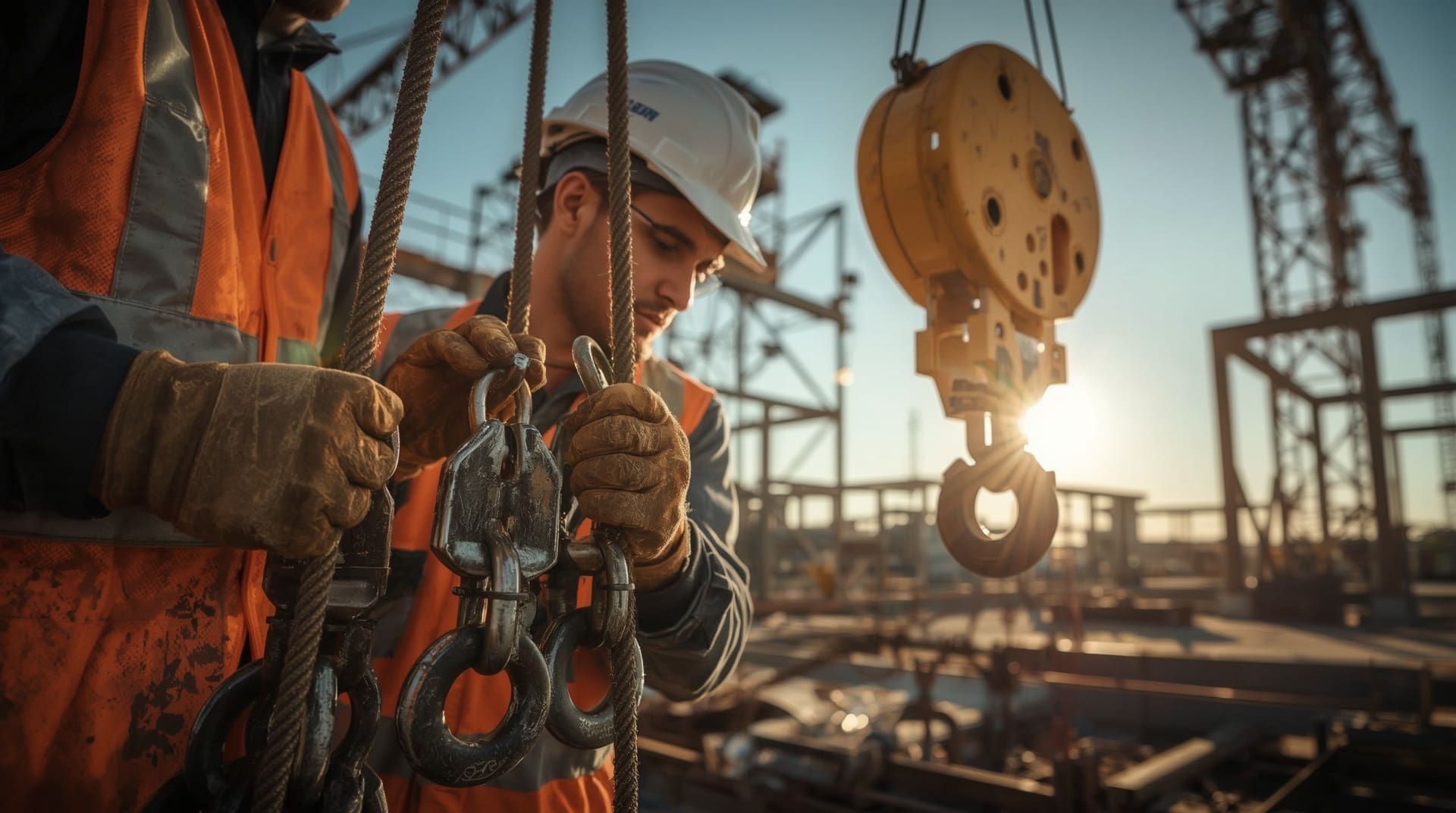
A qualified rigger is responsible for tasks directly tied to safe load handling. Their duties begin before the crane ever moves and continue until the load is secured at its destination.
- Inspecting rigging hardware: The rigger must check slings, shackles, hooks, wire rope, and other hardware before each use for damage or wear.
- Selecting the correct rigging method: The rigger must match the rigging configuration to the load’s weight, shape, and center of gravity.
- Calculating or confirming load weight: The rigger must know the load weight and ensure it does not exceed the rated capacity of any rigging component.
- Attaching the load properly: The rigger must connect the rigging in a way that keeps the load stable during the entire lift.
- Communicating with the crane operator: The rigger must signal or communicate clearly when the load is ready and when something is unsafe.
- Detaching the load safely: Once the load reaches its landing spot, the rigger must remove rigging hardware safely and store it correctly.
These responsibilities require hands-on skill and judgment. A worker who simply hooks a chain to a load without understanding load dynamics does not meet the OSHA standard, regardless of how much on-the-job time they have logged.
Knowledge and Skills a Qualified Rigger Must Possess

OSHA expects a qualified rigger to demonstrate specific technical knowledge. The standard does not list every item, but enforcement guidance and industry consensus have established a clear picture of what the person must know.
Load Calculations and Weight Estimation
The rigger must be able to estimate or confirm the weight of a load before the lift begins. This includes reading load charts, understanding how weight shifts in non-symmetrical loads, and knowing how to account for rigging hardware weight.
Rigging Hardware Identification and Ratings
The qualified rigger must recognize different types of slings, including wire rope, chain, synthetic web, and round slings, and know the working load limit (WLL) of each. WLL is the maximum load a piece of hardware is rated to carry under normal conditions. Using hardware beyond its WLL is a direct OSHA violation and a serious safety hazard.
Hitch Configurations
Different hitch types produce different effective load capacities. A straight vertical hitch, a choker hitch, and a basket hitch each affect the WLL differently. A qualified rigger must understand how the angle of lift changes the effective capacity of a sling, especially as sling angles decrease toward horizontal.
Inspection Criteria
The rigger must know when to remove rigging equipment from service. Criteria include visible deformation, broken wires in wire rope, cuts or tears in synthetic slings, and corrosion on chain links. Knowing the current wire rope replacement criteria is part of this knowledge base, since worn or damaged wire rope must be removed before it causes a failure.
Load Control and Tag Lines
A qualified rigger must understand how to use tag lines to control load swing and rotation. Improper load control can knock over nearby workers or strike structures, even when the crane operator is skilled.
| Knowledge Area | Why It Matters | Risk If Missing |
|---|---|---|
| Load weight and center of gravity | Prevents overload and tip-over | Dropped or tipped load |
| Working load limits | Keeps hardware within rated capacity | Hardware failure during lift |
| Hitch configurations and sling angles | Correct capacity selection | Overloaded sling, sling slip |
| Pre-use inspection | Identifies damaged equipment | Equipment failure mid-lift |
| Load control and tag lines | Prevents load swing injuries | Worker struck by moving load |
How Experience and Training Both Count Toward Qualification
OSHA’s definition allows two pathways to becoming a qualified rigger: formal training and documented experience. Many workers have years of field time but lack structured instruction on load calculations or inspection criteria. Both pathways have real value, but neither alone is automatically sufficient.
A worker with extensive crane-side experience may have strong practical instincts but still lack the ability to calculate sling angles mathematically. A worker who just completed a training course may understand the theory but lack the hands-on feel for how loads behave. The strongest qualified rigger combines both.
Employers bear responsibility for verifying that each rigger on their crew actually meets the standard. A supervisor who assigns rigging duties to someone who is not qualified can face OSHA citations and personal liability if an incident occurs.
Qualified Rigger vs. Competent Person: Understanding the Difference
OSHA uses several defined terms in the crane and rigging rules. Two that often get confused are “qualified rigger” and “competent person.” They are not the same.
A competent person, in OSHA’s definition, is someone who can identify existing and predictable hazards in the surroundings and who has the authority to take prompt corrective action. A competent person must be designated by the employer and has stop-work authority.
A qualified rigger focuses specifically on the technical ability to rig loads correctly. A rigger can be both qualified and competent if they meet both definitions. On many job sites, the same person fills both roles, but the employer must consciously assign each designation and verify the worker meets both sets of criteria.
Mixing up these terms can lead to incomplete safety programs. Assigning someone as a competent person for rigging tasks when they lack the technical knowledge to meet the qualified rigger standard creates a compliance gap.
Rigger Level I and Rigger Level II Training Programs
Formal training is the most reliable way to document that a worker meets the qualified rigger standard. Industry-recognized programs divide rigger training into skill levels.
Rigger Level I
Level I training covers fundamental rigging skills. Topics include basic hardware identification, pre-use inspection, simple hitch configurations, and load weight estimation. This level is appropriate for workers who rig standard, repetitive loads under direct supervision or as part of a larger crew.
Rigger Level II
Level II training covers more advanced topics, including complex lift planning, multi-crane lifts, and detailed sling angle calculations. Workers who routinely manage critical lifts or who serve as lead riggers on a crew benefit most from this level of instruction. Completing a Rigger Level II training program signals to employers and OSHA inspectors that the worker has gone beyond entry-level knowledge.
Both levels build a documented training record, which is valuable during an OSHA inspection. If an inspector asks how a rigger was qualified, a training certificate combined with a work history log is a strong answer.
Common Mistakes That Lead to Non-Compliance
Employers and workers make predictable errors when building a rigging safety program. Knowing these pitfalls helps you avoid them.
- Assuming experience equals qualification: Years on the job do not automatically satisfy OSHA’s standard. The worker must demonstrate specific knowledge, not just time served.
- No documentation: OSHA does not require a specific certificate, but having no record of training or experience evaluation is a compliance risk during inspections.
- Skipping pre-use inspections: Even experienced riggers sometimes skip inspections on busy job sites. This is one of the most cited rigging violations.
- Using damaged equipment: Keeping worn slings or bent shackles in service because replacing them is inconvenient is a direct violation and a leading cause of rigging failures.
- Ignoring sling angle effects: Many rigging accidents happen because workers did not account for how a low sling angle dramatically reduces the working load limit of a sling.
- No coordination with the crane operator: A qualified rigger must communicate with the operator. A breakdown in that communication is a common factor in load-related accidents.
How OSHA Inspectors Evaluate Qualified Rigger Compliance

During a crane-related inspection, an OSHA compliance officer will look for evidence that everyone attached to a rigging operation is qualified. The inspector may ask the rigger direct questions about load weights, hardware ratings, or inspection criteria. If the worker cannot answer, the inspector will likely determine the person does not meet the qualified rigger standard.
The inspector will also review any available training records, toolbox talk logs, and job hazard analyses. Sites with organized documentation fare much better during inspections, even when a minor procedural error is found. Documentation shows a culture of intentional safety management.
Citations under 29 CFR 1926.1425, which covers OSHA’s requirements for attaching the load, often reference the qualified rigger standard directly. Willful violations in this area carry penalties that can reach tens of thousands of dollars per citation.
The Role of the Qualified Rigger in Critical Lifts
A critical lift is a lift that requires extra planning because of its complexity, the weight of the load, or the proximity of workers and structures. OSHA and industry standards require a written lift plan for critical lifts. The qualified rigger plays a central role in executing that plan correctly.
During a critical lift, the rigger must follow the written plan precisely. Any deviation, such as a change in load weight or rigging configuration, must be reviewed and approved before the lift continues. The rigger also serves as a key communicator between the lift director and the crane operator during the operation.
Understanding the signal person’s role is also important here. A qualified rigger and a crane signal person certification holder often work alongside each other during complex lifts. The rigger controls what is on the hook, while the signal person communicates crane movements to the operator. Clear role separation reduces confusion and accident risk.
Getting Qualified: A Practical Path Forward
If you or your workers need to meet the qualified rigger OSHA standard, the path forward is straightforward. Start by assessing current knowledge against the core skills listed above. Identify gaps in load calculation ability, inspection knowledge, or hardware selection skills.
From there, structured training is the most efficient route. A recognized program covering both theory and hands-on practice will close knowledge gaps and produce documentation. Look for programs that follow ASME B30.9 (the standard for slings) and ASME B30.26 (rigging hardware) since these are the primary consensus standards OSHA references.
After training, employers should maintain a simple record for each rigger that includes the training completed, the date, the trainer or program name, and any evaluations of field competence. This record protects both the worker and the employer during inspections or incident investigations. Teams in the Raleigh and Cary area can access local training options through certified providers who offer both individual and group instruction tailored to construction and industrial rigging needs.
Final Thoughts on the Qualified Rigger Standard
The qualified rigger requirement exists because rigging errors kill and injure workers every year. OSHA’s standard is not a bureaucratic checkbox. It reflects the real-world knowledge a person needs to attach a load safely to a crane and bring it down without incident. Meeting that standard protects every worker in the lift zone, not just the rigger.
Whether you are a worker aiming to formalize your skills or an employer building a compliant rigging program, the investment in proper training and documentation pays off. A well-qualified rigging crew reduces incident risk, passes inspections more cleanly, and operates with greater confidence on every lift.
Frequently Asked Questions About the Qualified Rigger Standard
Does OSHA require a rigger to hold a specific certification card?
No, OSHA does not mandate a specific certification card for riggers the way it does for crane operators in some situations. However, the worker must be able to demonstrate the knowledge and skills required under the qualified rigger standard. A training certificate combined with documented experience is the most defensible way to show compliance during an inspection.
What is the difference between a qualified rigger and a certified rigger?
A qualified rigger meets OSHA’s defined standard through training, experience, or both. A certified rigger has passed a third-party written and practical exam through an accrediting body, such as NCCCO. Certification typically exceeds the minimum OSHA qualification standard and provides stronger documentation of competence.
Can one person serve as both the rigger and the signal person on a lift?
OSHA generally requires these to be separate roles when both are needed during a lift. The signal person must maintain visual contact with the crane operator and focus on directing crane movement. A rigger controlling the load on the hook cannot reliably perform both duties at the same time on most lifts.
How often does a qualified rigger need to be re-evaluated or retrained?
OSHA does not set a specific retraining interval for riggers. However, retraining is required when a rigger demonstrates deficiencies, when new equipment or procedures are introduced, or after an incident. Many employers choose an annual refresher cycle to keep skills current and documentation up to date.
What happens if an unqualified person rigs a load on a construction site?
Using an unqualified person to attach a load is a direct violation of 29 CFR 1926.1425. OSHA can cite the employer for each instance. If an incident results, the citation can be classified as willful or serious, carrying significant financial penalties and potential legal exposure for both the employer and the supervising employee.