A load testing company is a certified firm that tests cranes and other lifting equipment under rated loads to confirm they meet OSHA and ASME safety standards. The work combines hands-on mechanical testing with engineering review, ending in a signed certification document proving the equipment meets legal operating limits. That paperwork protects workers, satisfies insurance carriers, and keeps a jobsite compliant with federal regulations. Without it, a crane owner has no verified proof the equipment can safely lift its rated capacity.
For companies that operate tower cranes, mobile cranes, or overhead bridge cranes, this certification is not optional paperwork. It is a legal requirement tied directly to federal labor law, and skipping it can shut down a jobsite or trigger steep OSHA fines.
Key Takeaways
- Certification requires a physical test, typically at 100 percent to 125 percent of rated capacity, performed by a qualified third party, not a visual inspection alone.
- OSHA 29 CFR 1926.1400 and ASME B30.5 govern mobile crane testing, while ASME B30.2 applies to overhead and gantry cranes.
- Annual load testing is required for most crane classes, with more frequent testing for cranes handling critical lifts or operating in high-cycle environments.
- Costs typically run between $800 and $6,500 depending on crane type, capacity, and location, with mobile crane tests on the lower end and tower crane tests on the higher end.
- Third-party certification is generally required by OSHA when the testing company has no financial stake in whether the crane passes or fails.
What Does Crane Safety Certification Involve?
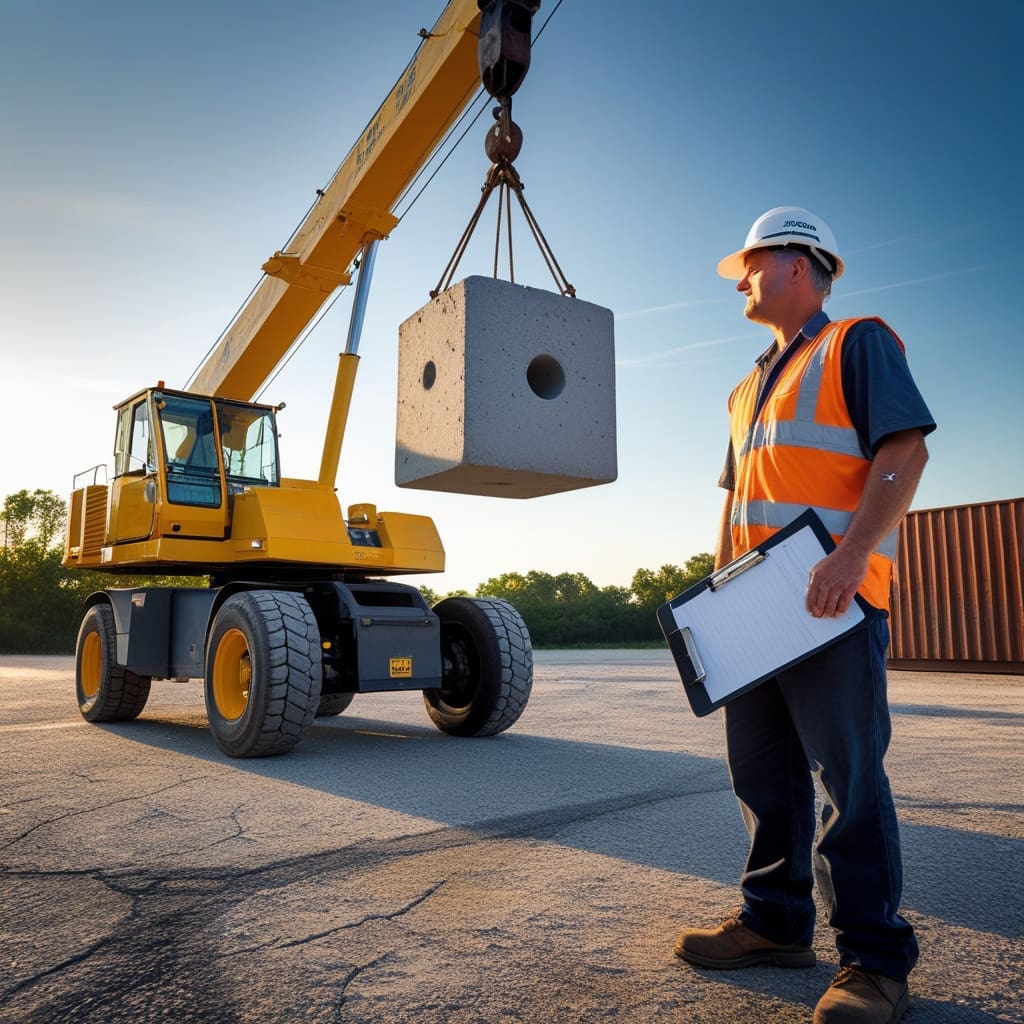
Crane safety certification involves a documented combination of mechanical load application, structural inspection, and functional testing, all performed against a specific capacity chart for that crane model. A certified technician does not simply eyeball the equipment. The technician rigs a known weight (often concrete blocks, water bags, or calibrated test weights), raises it through the crane’s full range of motion, and records how the boom, hoist, brakes, and limit switches respond under stress.
The written certification that follows includes the test load amount, the duration the load was held, any deflection measurements, and a pass or fail determination signed by a qualified person as defined under ASME B30 standards. This signature carries legal weight, since it becomes the record an OSHA inspector or insurance adjuster will request after an incident.
Which Regulations Govern Crane Load Testing?
Crane load testing in the United States is governed primarily by OSHA 29 CFR 1926.1400 for construction cranes and derricks, alongside the ASME B30 series of consensus standards that OSHA incorporates by reference. ASME B30.5 covers mobile and locomotive cranes, ASME B30.2 covers overhead and gantry cranes, and ASME B30.4 covers portal, tower, and pedestal cranes. Each standard specifies test load percentages, inspection intervals, and documentation requirements specific to that crane class.
Beyond federal rules, many states layer on additional requirements. New York City, for example, mandates annual load testing through the Department of Buildings for all climber and tower cranes operating within city limits, with test results filed before a crane can receive its operating permit renewal. California’s Division of Occupational Safety and Health (Cal/OSHA) enforces similar rules under Title 8, Section 5006. A reputable load testing company tracks these overlapping requirements so a crane owner is not caught between conflicting jurisdictions.
What Is the Difference Between a Proof Load Test and a Rated Load Test?
A proof load test verifies a new or newly repaired crane can safely handle a load above its rated capacity, typically 125 percent, while a rated load test confirms an in-service crane still performs correctly at 100 percent of its posted capacity. Proof testing happens once, at commissioning or after major structural repair. Rated testing happens on a recurring schedule, usually annually, to confirm the crane has not degraded through normal wear.
How Does a Load Testing Company Certify Crane Compliance?
Certification follows a structured sequence that a load testing company repeats for every crane it tests, regardless of size or type. Each step carries a specific figure that must be documented for the certification to hold up under audit.
- Pre-test inspection (1 to 3 hours): A certified inspector checks wire rope wear against the 6×19 or 6×36 discard criteria, hook deformation beyond 10 percent of the original throat opening, and hydraulic hose condition before any weight is attached.
- Test load selection (within 1 to 2 percent accuracy): The company selects calibrated weights matching 100 percent of rated capacity for annual recertification, or 110 to 125 percent for a new crane proof test, verified against a certified scale.
- Static load hold (10 minutes minimum): The crane lifts the test load a short distance off the ground and holds it motionless for at least 10 minutes per ASME B30.5 guidance, while technicians watch for boom deflection exceeding manufacturer tolerance.
- Dynamic function test (full range of motion): The crane cycles through boom extension, rotation, and hoist travel at rated capacity to confirm brakes hold the load within a 3-inch drift tolerance and limit switches engage correctly.
- Measurement and data logging (typically same day): Technicians record deflection, drift, hydraulic pressure drop, and cycle time, comparing every figure against the OEM load chart tolerance.
- Certification issuance (1 to 5 business days): A qualified person signs the load test certificate, which includes the test date, load applied, pass or fail status, and the next required test date, usually 12 months out.
According to the Crane Institute of America’s inspection data, roughly 8 to 12 percent of cranes submitted for annual recertification fail on the first attempt, most commonly due to wire rope wear or brake drift exceeding tolerance. A failed test does not end the process. It triggers a repair order, followed by a retest once the deficiency is corrected.
What Load Percentages Are Used in Certification Tests?
Annual load test requirements typically call for a test at 100 percent of the crane’s rated capacity, while initial commissioning tests or post-repair tests require 110 to 125 percent depending on the standard applied. ASME B30.2 specifies 100 to 125 percent for overhead cranes, with the exact figure tied to whether the test follows new installation, relocation, or routine annual recertification. ASME B30.5 generally calls for 100 to 110 percent for mobile cranes undergoing periodic testing.
Exceeding these percentages is not a safety margin exercise. Loading a crane beyond the standard’s upper limit can introduce permanent structural deformation that shortens the equipment’s service life, which is why a competent testing company never freelances the test load figure based on client preference.
How Much Does Professional Crane Load Testing Cost?
Professional crane load testing typically costs between $800 and $6,500 per crane, with the final price shaped by crane capacity, test type, and travel distance for the testing crew. A small forklift-style crane or jib crane sits at the low end of that range, while a large tower crane requiring multiple test weights and a two-day crew deployment sits at the high end.
- Jib and gantry cranes (under 5 tons): $800 to $1,800 per annual test
- Mobile hydraulic cranes (5 to 50 tons): $1,500 to $3,200 per annual test
- Overhead bridge cranes (industrial facilities): $1,200 to $2,800 per annual test
- Tower cranes (construction sites): $3,500 to $6,500 per annual test, plus permit filing fees in cities like New York
- Proof load testing for new installations: $2,500 to $8,000, since this requires custom test weight calibration and engineering sign-off
Travel surcharges add $150 to $500 for sites more than 50 miles from the testing company’s base location, and expedited scheduling within 48 hours can add another 15 to 25 percent to the base price. Most companies bundle the pre-test inspection, the load test itself, and the written certificate into one flat fee, so it is worth confirming whether retesting after a failed result is included or billed separately.
Why Hire a Third-Party Load Testing Company?
Hiring a third party load test crane provider ensures the test results are unbiased, since the testing company has no financial interest in the crane passing. OSHA’s general industry guidance and most insurance underwriting standards favor or require third-party certification specifically because an in-house inspection creates an obvious conflict of interest. If the same company that owns or leases the crane also certifies it, the incentive to overlook minor deficiencies is real.
Per the Specialized Carriers & Rigging Association’s safety bulletin on third-party verification, insurance carriers increasingly deny claims tied to crane failures when the certifying party cannot demonstrate independence from the crane owner. A third-party certificate also transfers more easily during equipment sales, lease agreements, or subcontractor bidding, since the receiving party does not need to question who performed the test or why.
Does OSHA Require Third-Party Testing?
OSHA requires a “qualified person” to perform crane load tests, and in many contexts this must be someone independent of normal crane operation. Under 29 CFR 1926.1412, periodic inspections must be conducted by someone who meets the qualified person definition through training, knowledge, and experience, and larger contractors typically satisfy this by contracting an external load testing company rather than relying solely on in-house maintenance staff.
How Do You Choose the Right Load Testing Company?
You choose the right load testing company by verifying its technicians hold current NCCCO or Crane Institute of America certification, confirming it carries general liability and professional errors and omissions insurance, and checking that it issues certificates referencing the specific ASME and OSHA standards applicable to your crane class. A company that cannot name the exact standard it tests against is not one you want signing off on equipment that lifts multi-ton loads over your workers.
- Credentials: Ask for technician certification numbers and confirm they are current, not expired.
- Calibration records: Test weights and dynamometers should carry calibration certificates dated within the past 12 months.
- Turnaround time: A reliable company issues the written certificate within 5 business days, not weeks later.
- Insurance coverage: Confirm liability coverage of at least $1 million per occurrence, which is standard across most industrial testing contracts.
- Track record: Ask how many cranes of your specific type (tower, mobile, overhead) the company has certified in the past 12 months.
According to NCCCO’s annual industry survey, facilities that switch testing providers more than once every two years report higher rates of documentation discrepancies during OSHA audits, often because new providers are unfamiliar with a crane’s maintenance history. Consistency with a single qualified provider tends to produce cleaner compliance records over time.
What Happens After Certification?
After certification, the crane owner receives a signed certificate and an inspection tag that must be displayed on or near the crane’s control station, along with a scheduled date for the next required test, typically 12 months later. The certificate becomes part of the crane’s permanent maintenance file, which OSHA inspectors can request at any time during a workplace safety audit.
If the crane fails any portion of the test, the testing company issues a deficiency report instead of a certificate, outlining the specific failure point, whether that is excessive boom deflection, brake drift beyond tolerance, or wire rope degradation. The crane must be pulled from service until repairs are completed and a retest confirms compliance. Operating a crane past its certification expiration date, even by a single day, exposes the owner to OSHA citations that commonly start around $16,550 per violation for serious infractions, per OSHA’s current penalty schedule.
Ready to Certify Your Crane?
If your crane’s certification is approaching its 12-month expiration, or if you are commissioning new equipment that requires a proof load test, scheduling the inspection now avoids the scramble that comes with an expired tag and a stalled jobsite. Contact a certified load testing company to confirm your crane class, request a quote based on rated capacity, and lock in a test date before your current certificate lapses.
Frequently Asked Questions
How often does a crane need to be load tested?
Most cranes require load testing every 12 months, though some jurisdictions and crane types require more frequent testing. Tower cranes in cities like New York often face stricter annual deadlines tied to building permit renewals, while critical-lift cranes handling nuclear or heavy industrial loads may require testing every 6 months.
Can a crane operator perform their own load test?
No, a crane operator generally cannot certify their own equipment, since OSHA requires an independent qualified person to conduct the test. Operators can perform daily functional checks, but the formal certification test demands documented independence from day-to-day crane use.
What documents should I receive after a load test?
You should receive a signed load test certificate, a deficiency report if applicable, and an updated inspection tag for the crane. The certificate should reference the specific ASME standard applied, the exact test load percentage used, and the date of the next required test.
How long does a crane load test take to complete?
A typical crane load test takes between 2 and 6 hours, depending on crane size and complexity. Small jib cranes can be tested in under 2 hours, while tower cranes requiring multiple test weight configurations can take a full day.
What happens if a crane fails its load test?
A failed load test takes the crane out of service until the identified deficiency is repaired and a retest confirms compliance. The testing company documents the specific failure point, such as excessive deflection or brake drift, so repair crews know exactly what to address before resubmitting the crane for retesting.
Conclusion
A qualified load testing company certifies crane safety compliance through a documented sequence of inspection, calibrated load application, and signed certification tied directly to OSHA and ASME standards. Skipping this process or relying on an uncertified in-house check leaves a crane owner exposed to fines, insurance disputes, and the far greater risk of equipment failure under load. Scheduling testing with a credentialed, independent provider before your current certificate expires keeps your crew safe and your jobsite running without interruption.