
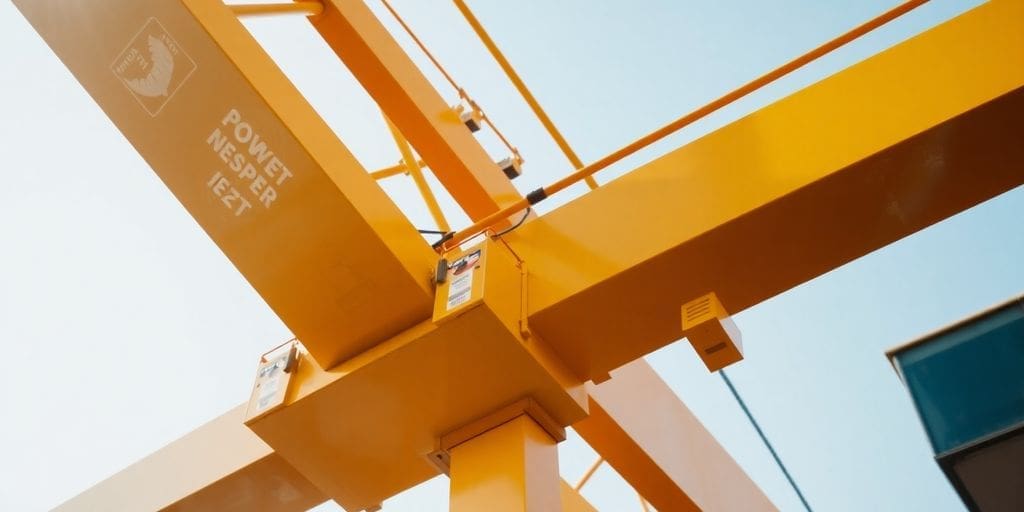
A crane inspection checklist is a structured document that guides operators, riggers, and qualified inspectors through every mechanical, structural, and safety component of a crane before, during, and after use. It exists to catch wear, damage, or malfunction before a crane lifts a single pound. Under federal regulation, specifically 29 CFR 1926.1412 for construction cranes and 29 CFR 1910.179 for general industry overhead and gantry cranes, employers are legally required to perform these checks on a defined schedule. Skipping this process is not a minor administrative lapse. It is one of the leading contributors to crane-related injuries and fatalities recorded by the Bureau of Labor Statistics each year.
You do not need to guess at what belongs on this checklist. OSHA, ASME B30 standards, and the National Commission for the Certification of Crane Operators (NCCCO) have already defined the categories, frequencies, and documentation requirements that apply to nearly every crane type in operation across the United States. This article lays out exactly what those requirements look like in practice, broken down by inspection frequency, so you can build or audit a checklist that actually holds up under an OSHA site visit.
Key Takeaways
- Federal law requires three distinct inspection tiers for most cranes: shift (daily) inspections, monthly documented inspections, and annual comprehensive inspections.
- 29 CFR 1926.1412 governs construction cranes, while 29 CFR 1910.179 applies to overhead and gantry cranes used in general industry settings such as warehouses and manufacturing plants.
- Only a qualified person, meaning someone with documented knowledge and training on that specific crane type, may sign off on monthly and annual inspections.
- Monthly inspection records must be retained for a minimum of twelve months, and annual inspection records should be kept for the service life of the crane.
- OSHA penalties for missing or falsified inspection records can reach $16,550 per serious violation and $165,514 for willful or repeat violations as of 2026, figures that are adjusted annually for inflation.
- Common crane failures caught through proper inspection include wire rope fraying, hydraulic fluid leaks, brake slippage, and load chart overloading.
What OSHA and ASME Standards Actually Require
Two federal standards govern most crane inspections in the United States, and knowing which one applies to your equipment matters. Construction site cranes, including mobile, crawler, and tower cranes, fall under 29 CFR 1926.1412, part of OSHA’s Subpart CC rule for cranes and derricks in construction. Overhead bridge cranes, gantry cranes, and jib cranes used in manufacturing, warehousing, or fabrication settings fall under 29 CFR 1910.179 instead.
Daily (Shift) Crane Inspection Checklist
Every crane needs a quick visual check from the operator or a competent person before each shift’s first lift. It takes five to fifteen minutes. OSHA doesn’t require a written log, but many employers keep one to catch anything that changed since last use.
Check these items:
- Wire ropes and chains: Look for broken wires, kinking, or corrosion. Six or more broken wires in one rope lay means rejection under ASME B30.5.
- Hooks and latches: Confirm the safety latch works and check for cracks or throat opening beyond 15 percent of original size.
- Hydraulic and pneumatic systems: Check fluid levels and look for leaks.
- Controls and emergency stop: Test for sticking, delay, and instant power cutoff.
- Structural components: Scan the boom, jib, outriggers, and counterweights for damage.
- Tires or tracks, decals, and load charts: Confirm condition and legibility match current setup.
Any failed item takes the crane out of service until a qualified person fixes it. OSHA treats running a crane with a known defect as a serious violation, even without an incident.
Monthly Inspection Requirements
Beyond the daily visual scan, both 29 CFR 1926.1412 and 29 CFR 1910.179 require a documented monthly inspection performed by a qualified person, someone with recognized training and experience specific to that crane category. Unlike the shift inspection, the monthly inspection must be recorded in writing, dated, and signed, and those records must be retained for a minimum of twelve months.
Monthly inspections dig deeper into components that shift-based visual checks often miss:
- Brakes: Test hoist, swing, and travel brakes under load to confirm they hold securely without slippage or drift.
- Limit switches: Verify upper and lower travel limits engage correctly to prevent over-travel or two-blocking.
- Sheaves and drums: Check for wear grooves, cracks, or improper rope seating.
- Electrical systems: Inspect wiring for fraying, exposed conductors, or corrosion at connection points.
- Fasteners and pins: Confirm bolts, pins, and retaining devices are torqued to specification and free of shear cracks.
- Warning devices: Test horns, backup alarms, and anti-two-block alarms for proper function.
Employers who lease or rent cranes often assume the rental company handles monthly inspections. That assumption is frequently wrong, and OSHA holds the operating employer responsible for verifying compliance regardless of ownership. Always request the most recent inspection record in writing before accepting a rented crane onto a job site.
Annual Comprehensive Inspection: The Deep Dive
The annual, or Category 1, inspection is the most thorough tier and must be done by a qualified inspector, often a third-party specialist certified through NCCCO’s CIC program. Large tower or crawler cranes can take a full day or more, since covers and housings often need partial disassembly to check internal parts.
A comprehensive annual inspection generally covers:
- Structural integrity testing: Magnetic particle or dye penetrant testing on welds and high-stress members.
- Wire rope assessment: ASME B30.5 requires rope replacement once diameter reduction hits one-third or more.
- Load testing: Some jurisdictions require testing at 100 to 125 percent of rated capacity after major repairs or yearly for tower cranes.
- Drive mechanism teardown: Gears, bearings, and couplings checked for pitting, scoring, or excess backlash.
- Boom and jib deflection: Checked for permanent bending or twist beyond tolerance.
- Electrical panel review: Relays, contactors, and PLCs inspected on modern systems.
- Documentation reconciliation: Monthly and shift records checked against maintenance history.
Keep annual inspection reports for the crane’s entire service life, not just a year. Insurers and OSHA often ask for years of past reports when investigating incidents or renewing policies.

Inspection Frequency and Responsibility at a Glance
| Inspection Tier | Frequency | Who Performs It | Documentation Required |
|---|---|---|---|
| Shift/Daily | Before each shift or use | Operator or competent person | Not federally required, but recommended |
| Monthly | Every 30 days | Qualified person | Written record, retained 12 months minimum |
| Annual/Comprehensive | Every 12 months, or per manufacturer schedule | Certified crane inspector (NCCCO CIC or equivalent) | Written record, retained for service life of crane |
| Post-repair or post-incident | Immediately following event | Qualified person | Written record before crane returns to service |
Who Is Qualified to Sign Off on Inspections
OSHA does not allow just anyone to sign off on monthly or annual crane inspections. A “qualified person” under 29 CFR 1926.1401 is defined as someone who, by possession of a recognized degree, certificate, or professional standing, or by extensive knowledge, training, and experience, has successfully demonstrated the ability to solve problems related to the specific crane and inspection task at hand. In practice, this usually means formal training through a recognized program, hands-on experience with that specific crane class, and often a written or practical competency assessment.
For annual comprehensive inspections, many employers turn to inspectors holding NCCCO’s Crane Inspector Certification (CIC), which requires passing both a core exam and a specialty exam covering the specific crane type, along with documented field experience. Some states and municipalities, including several jurisdictions in North Carolina, also require crane operators themselves to hold NCCCO operator certification before touching the controls, separate from the inspector qualification.
A crane checklist is only as reliable as the person filling it out. Training and documented competency matter as much as the checklist itself.
Recordkeeping: What to Keep and for How Long
Documentation is not optional paperwork; it is the evidence that proves compliance when OSHA or an insurance adjuster comes asking. At minimum, maintain the following records:
- Monthly inspection reports for the previous twelve months, available on-site or accessible within a reasonable time frame.
- Annual comprehensive inspection reports for the full service life of the crane.
- Repair and maintenance logs tied to each inspection finding, showing the deficiency identified and the corrective action taken.
- Operator and inspector certification records, proving each individual was qualified at the time they performed the work.
- Load test certificates, where applicable, particularly for tower cranes and cranes used in critical lifts.
Digital inspection management platforms have largely replaced paper logs on larger job sites, since they timestamp entries automatically and flag overdue inspections before a crane can be dispatched. If your operation still relies on paper checklists stored in a site trailer, consider that a single lost binder can leave you without proof of compliance during an audit, even if every inspection was actually performed correctly.
Common Crane Hazards a Checklist Is Designed to Catch
Most serious crane incidents trace back to a handful of recurring failure points, and a well-built checklist targets each one directly.
- Overloading: Exceeding the rated capacity listed on the load chart, often due to miscalculating load weight or ignoring boom angle deratings.
- Wire rope failure: Sudden rope snapping caused by unnoticed fraying, corrosion, or improper spooling.
- Electrical contact: Booms or cables contacting overhead power lines, a leading cause of crane-related fatalities according to OSHA fatality data.
- Brake failure: Loss of load control during hoisting or lowering due to worn brake linings or hydraulic pressure loss.
- Ground instability: Outriggers set on unstable or uneven ground, leading to tip-over incidents.
- Rigging errors: Improper sling angles or damaged rigging hardware that fails under load.
Each of these hazards has a corresponding checklist item across the three inspection tiers described earlier. This is why treating the checklist as a formality, rather than a genuine diagnostic tool, defeats its entire purpose.
Cost of Noncompliance and the Case for Prevention
OSHA penalties for crane-related violations are not trivial. As of 2026, the maximum penalty for a serious or other-than-serious violation stands at $16,550, while willful or repeat violations can reach $165,514 per incident. These figures are adjusted annually for inflation, so employers should verify current amounts each year rather than relying on older published numbers.
Beyond direct fines, the financial exposure from a crane failure includes equipment replacement costs that can run from $50,000 for smaller mobile cranes to well over $1 million for large tower cranes, plus potential workers’ compensation claims, wrongful death litigation, and project delays that can stretch into months. Insurance carriers also frequently raise premiums or deny claims outright when inspection documentation is missing or incomplete at the time of an incident.
Compare that exposure to the actual cost of proper inspection: a third-party annual comprehensive inspection typically runs between $500 and $2,500 depending on crane size and complexity, while monthly qualified-person inspections performed in-house add only a few hours of labor per month. The math strongly favors prevention over reaction.
Building Your Own Crane Inspection Checklist: A Practical Starting Point
If you are assembling a checklist from scratch rather than adopting a manufacturer or third-party template, structure it around these five sections to align with OSHA and ASME expectations:
- Identification section: Crane make, model, serial number, location, and date of inspection.
- Shift-level visual items: The eight daily items listed earlier in this article, checked off before every use.
- Monthly qualified-person items: Brakes, limit switches, sheaves, electrical systems, and warning devices, signed and dated.
- Annual comprehensive items: Structural testing, wire rope replacement assessment, and drive mechanism review, performed by a certified inspector.
- Deficiency and corrective action log: A running record of every finding, the date it was resolved, and who signed off on the repair.
Certified Safety Experts, based in Raleigh, North Carolina, provides NCCCO crane inspector training along with crane operator and rigger training programs designed to prepare your team to build and execute checklists that meet these exact standards. If your organization operates cranes anywhere in North Carolina, including Charlotte, Durham, Greensboro, Wilmington, Winston-Salem, or Asheville, reaching out for a training consultation now can prevent a costly citation later. Contact Certified Safety Experts at (919) 373-6769 to schedule crane inspector training or to review your current inspection program against current OSHA requirements.
Conclusion
A crane inspection checklist only protects your workforce and your compliance record when it is followed consistently and by qualified people. Daily visual checks, documented monthly inspections, and annual comprehensive reviews each serve a distinct purpose, and skipping any one of them leaves a gap that wear, corrosion, or mechanical failure can exploit. Treat your checklist as a living safety tool rather than a box-checking exercise, and keep records that prove your diligence long after the inspection itself is finished.
Frequently Asked Questions
How often does OSHA require crane inspections?
OSHA requires three inspection frequencies: before each shift, monthly, and annually. Shift inspections are visual and performed by the operator, monthly inspections must be documented by a qualified person, and annual comprehensive inspections must be performed by a certified crane inspector.
Who is legally allowed to perform a crane inspection?
A qualified person must perform monthly inspections, and a certified inspector must perform annual comprehensive inspections. OSHA defines a qualified person under 29 CFR 1926.1401 as someone with documented training, knowledge, and demonstrated ability specific to that crane type, often verified through NCCCO certification.
What happens if a crane fails its inspection?
The crane must be removed from service immediately and cannot resume operation until the deficiency is corrected by a qualified person. Operating a crane with a known defect exposes the employer to a serious OSHA citation, even if no accident results from continued use.
How long should crane inspection records be kept?
Monthly inspection records must be kept for at least twelve months, while annual comprehensive inspection records should be retained for the entire service life of the crane. Insurance carriers and OSHA investigators frequently request several years of historical records during an incident review.
How much does a professional crane inspection cost?
A third-party annual comprehensive inspection typically costs between $500 and $2,500, depending on crane size and complexity. Larger tower or crawler cranes requiring non-destructive testing and partial disassembly tend to fall at the higher end of that range, while smaller mobile cranes generally cost less.