

A crane that looks fine is not the same as a crane that is safe to operate. Load testing is how you close that gap. It puts the crane under controlled stress to prove the structure, brakes, and mechanical systems can handle real working loads before a single production lift takes place.
This guide covers the full load testing process: when a test is required, what proof load percentages apply, how dynamic and static tests differ, and exactly what your documentation needs to include after a test.
Key Takeaways
- Rated load tests use 100–125% of the crane’s capacity — the exact percentage depends on the crane type, standard, and the scope of repairs or modifications performed.
- Dynamic and static tests serve different purposes — dynamic tests verify motion systems and brakes, while static tests verify structural integrity under sustained load.
- Load testing is required after major repairs, modifications, and new installations — not just as a periodic check, but as a formal acceptance step.
- ASME B30 and OSHA 1910.179 define minimum test requirements — jurisdictional requirements or manufacturer specifications may call for higher proof loads.
- Documentation must capture pre-test inspection, test loads, test results, and sign-off — incomplete records create liability and fail audits.
- A qualified person must plan and oversee the test — in many jurisdictions, a professional engineer must certify proof load results.
What Is a Crane Load Test and Why Is It Required?

Quick Answer: A crane load test applies a controlled, measured weight to a crane to verify that its structure, brakes, and mechanical systems perform safely at or above rated capacity. Tests are required after new installation, major repairs, and structural modifications before returning the crane to service.
A load test is a formal performance verification. You are not simply lifting something heavy — you are running a structured protocol that confirms every system on the crane responds correctly under load.
The requirement comes from multiple sources. ASME B30.2 covers overhead and gantry cranes. ASME B30.11 covers monorails. OSHA 1910.179 applies to overhead cranes in general industry. These standards share a common principle: a crane that has been altered, repaired, or newly installed cannot return to service based on visual inspection alone.
Load testing answers three questions that inspection alone cannot:
- Does the structure deflect within acceptable limits under load?
- Do the brakes hold when the hoist is loaded?
- Do motion systems operate without excessive drift or failure under load?
When Is a Load Test Required for a Crane?
Quick Answer: A load test is required after new crane installation, any structural repair or replacement, modifications that change the crane’s rated capacity, replacement of major load-bearing components, and after any incident that may have compromised structural integrity.
New Crane Installations
Every newly installed crane must pass a load test before it enters regular service. This applies whether the crane is brand new or a relocated used crane. Relocation changes the supporting structure, runway alignment, and connection points — all of which must be verified under load at the new location.
After Major Repairs
Not every repair triggers a full load test. Minor maintenance, such as replacing rope, lubrication, or electrical contactors, typically does not. Major repairs do. The threshold is whether the repair involved a load-bearing component or the structural frame.
Examples of repairs that require a subsequent load test:
- Bridge girder weld repair or replacement
- End truck or runway beam replacement
- Hoist drum or gearbox replacement
- Hook block assembly replacement
- Structural modifications to the trolley frame
After Capacity Modifications
If an engineer has re-rated a crane, either upward or downward, a load test at the new rated capacity is required. Uprating without a load test is a direct safety violation. Downrating still requires documentation and often a test to confirm the limiting systems are correctly configured.
After Incidents or Suspected Overloads
If a crane has experienced an overload event, dropped a load, or been in a collision, assume a load test is required. Structural damage is not always visible. A test combined with a structural inspection confirms whether the crane can return to service.
What Are the Proof Load Percentages for Crane Load Tests?
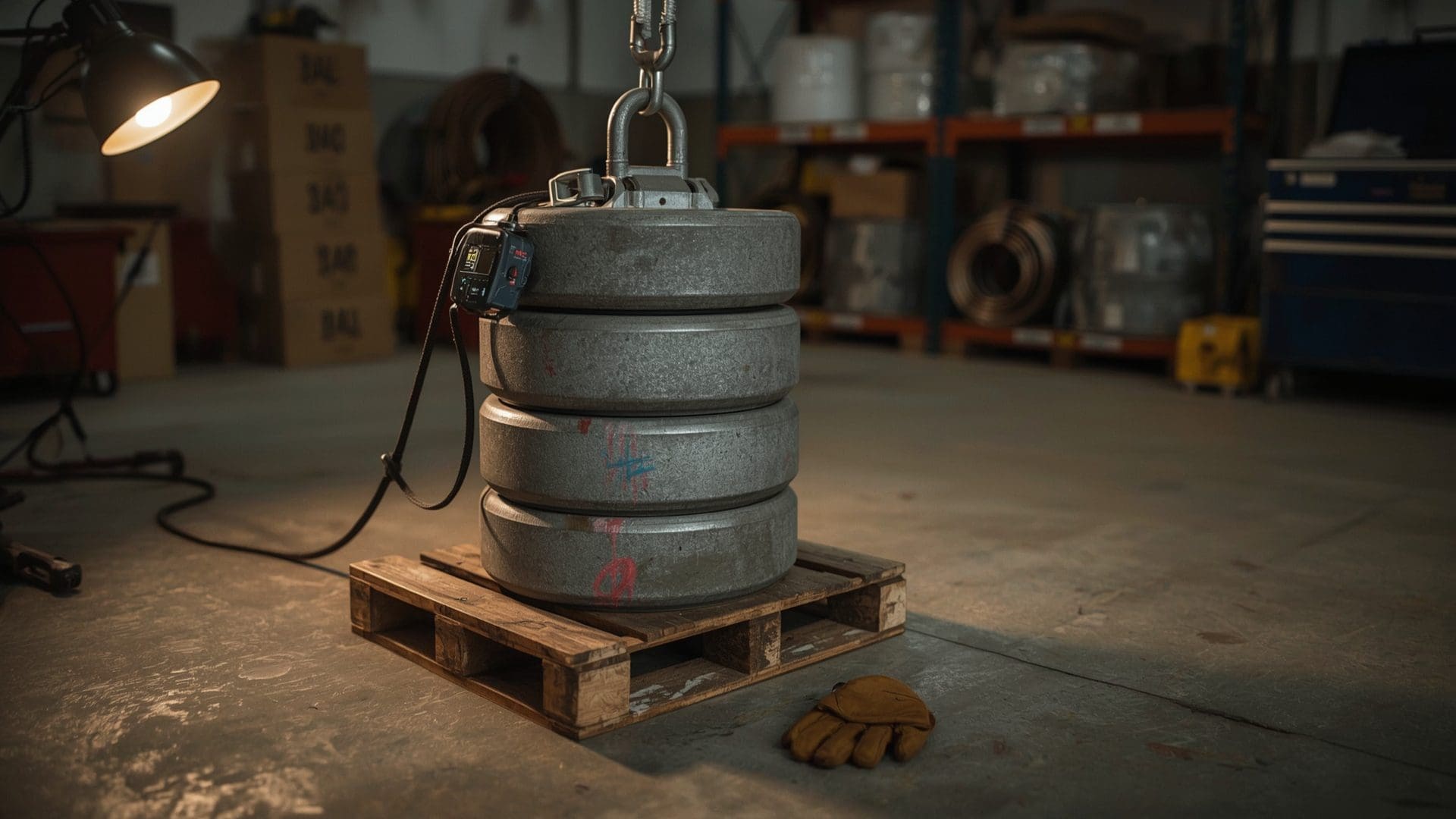
Quick Answer: Proof load percentages typically range from 100% to 125% of the crane’s rated capacity. Overhead cranes per ASME B30.2 are tested at 125% for new installations. Repairs may call for 100–110%. Manufacturer specs or jurisdictional requirements can set higher thresholds.
Proof Load Requirements by Standard and Crane Type
| Crane Type | Governing Standard | New Installation Proof Load | Post-Repair Proof Load | Test Duration (Static) |
|---|---|---|---|---|
| Overhead Bridge Crane | ASME B30.2 / OSHA 1910.179 | 125% of rated load | 100–125% of rated load | 10 minutes minimum |
| Monorail and Underhung Crane | ASME B30.11 | 125% of rated load | 100–110% of rated load | 10 minutes minimum |
| Jib Crane | ASME B30.12 | 125% of rated load | 100–125% of rated load | 10 minutes minimum |
| Mobile Crane | ASME B30.5 | Per manufacturer load chart | 100% of rated load at critical radius | 5 minutes minimum |
| Overhead Crane (EU FEM / EN 13001) | EN 13001-1 | 125% of rated load | 110% of rated load | 10 minutes minimum |
These are minimum requirements. A jurisdictional authority having jurisdiction (AHJ) — such as a state OSHA plan, a local building department, or a port authority — may require higher proof loads. Always verify before planning the test.
What Is the Difference Between a Dynamic and a Static Load Test?
Quick Answer: A static load test suspends a proof load without motion to check structural deflection and brake holding capacity. A dynamic load test operates the crane through all motions under load to verify brakes, speed controls, limit switches, and mechanical systems perform correctly during real movement.
Static Load Test: Purpose and Protocol
A static test measures whether the crane holds a load without drift, structural failure, or excessive deflection. You are testing the structure and brakes, not the motion systems.
Standard static test procedure:
- Position the trolley at mid-span of the bridge (the point of maximum deflection).
- Lift the test load to a height of 12–18 inches above the floor.
- Hold the load for the required duration (typically 10 minutes).
- Measure bridge girder deflection under load and compare to the allowable limit.
- Lower the load and check for permanent deformation or residual sag.
Allowable Deflection Limits for Overhead Cranes
| Crane Class | Span Type | Allowable Live Load Deflection | Governing Reference |
|---|---|---|---|
| CMAA Class A–D (Standard) | Single and Double Girder | Span ÷ 600 | CMAA Specification 70/74 |
| CMAA Class E–F (Heavy Duty) | Single and Double Girder | Span ÷ 800 | CMAA Specification 70/74 |
| Monorail Beam | Simply Supported | Span ÷ 450 | ASME B30.11 |
| Jib Crane Boom | Cantilevered | Boom Length ÷ 225 | ASME B30.12 |
Dynamic Load Test: Purpose and Protocol
A dynamic test runs the crane under load through all available motions. You are verifying that the crane functions correctly when it is actually working, not just holding still.
Standard dynamic test sequence:
- Load the hoist to 100–110% of rated capacity (lower than static proof load in most protocols).
- Perform hoist raise and lower at full speed and at slow speed (if variable speed is available).
- Test the hoist brake by raising the load, then de-energizing the hoist motor and confirming the brake holds without drift.
- Travel the bridge in both directions while loaded.
- Travel the trolley across the full span in both directions while loaded.
- Test all limit switches: upper limit, lower limit, bridge travel limits, and trolley travel limits.
- Test the load limiter or overload protection device if equipped.
Key Differences at a Glance
| Attribute | Static Load Test | Dynamic Load Test |
|---|---|---|
| Primary Purpose | Structural integrity and brake holding | Motion system and brake function under movement |
| Typical Proof Load | 125% of rated load | 100–110% of rated load |
| Crane Motion During Test | None — load is suspended statically | All motions exercised with load applied |
| Measurement Taken | Deflection, permanent set, brake drift | Brake hold, limit switch function, drift, speed |
| Test Duration | 10 minutes typical | Full motion cycle, typically 30–90 minutes total |
| Risk Level | Lower — no movement | Higher — load in motion, requires exclusion zone |
How Do You Prepare a Crane for a Load Test?

Quick Answer: Prepare by completing a full pre-test inspection, confirming all safety devices function, calculating the exact test load with calibrated weights or a load cell, establishing an exclusion zone, and briefing the test crew on emergency procedures before any load is applied.
Pre-Test Inspection Checklist
A load test should never be the first time you look at the crane. The pre-test inspection confirms the crane is mechanically ready to be tested safely.
- Inspect all wire rope for damage, kinking, broken wires, and correct spooling on the drum
- Inspect the hook for cracks, deformation, and proper latch function
- Verify the hoist brake operates correctly under no-load conditions
- Check all electrical connections, contactors, and limit switch settings
- Inspect bridge and trolley wheels, rails, and end stops
- Confirm the load block and reeving configuration match the crane’s design
- Verify the runway structure and building connections show no visible damage
Test Load Calibration
The test load must be known with accuracy. Guessing the weight of concrete blocks or scrap material is not acceptable. Use one of these methods:
- Calibrated test weights: Certified, stamped weights with known mass values. Most accurate and easiest to document.
- Load cell with digital readout: A calibrated load cell rigged between the hook and the test weight gives a live readout of actual applied load.
- Water bags: Filled to a known volume and density, useful when certified weights are unavailable. Require calibrated flow measurement.
The test load must be within ±2% of the required proof load in most protocols. Exceeding that tolerance — on the high side — can overstress a crane that has already been repaired.
Site Safety Controls
Before lifting any test load, establish a physical exclusion zone beneath and around the lift path. No personnel should be in the exclusion zone while the load is suspended. Post a spotter at the crane controls and assign one person to observe the structure and call a stop if anything looks wrong.
What Measurements and Checks Are Taken During a Load Test?
Quick Answer: During a static test, measure girder deflection at mid-span using a transit, string line, or laser level. Check for permanent set after unloading. During a dynamic test, observe brake holding time, limit switch trip points, and any signs of overheating, vibration, or unusual noise.
Deflection Measurement Methods
| Measurement Method | Accuracy | Best Used For | Equipment Required |
|---|---|---|---|
| Optical Level / Transit | ±1 mm | Long-span overhead cranes | Surveying level, graduated rod |
| Laser Level | ±2 mm | Medium-span cranes, industrial settings | Self-leveling laser, target plate |
| String Line and Rule | ±3–5 mm | Short-span cranes, field conditions | Taut wire, steel rule |
| Digital Dial Indicator | ±0.1 mm | Precision testing, jib cranes | Magnetic base, digital indicator |
Brake Drift Test
After raising the proof load to test height, de-energize the hoist motor and observe for drift. Most standards require zero visible drift within a 10-minute hold period. Any measurable lowering of the load under brake-only conditions is a test failure. The crane must not return to service until the brake is repaired and the test is repeated.
Limit Switch Verification
Upper limit switches must stop the hook block before it contacts the drum or sheaves. During the dynamic test, approach the upper limit at slow speed with the test load suspended. Confirm the limit trips and stops the hoist motion. Then manually reset and verify the lower limit switch in the same manner.
What Documentation Is Required After a Crane Load Test?

Quick Answer: Load test documentation must include the pre-test inspection record, calibrated test load value, static deflection measurements, brake drift observations, limit switch test results, pass or fail determination, the name and qualifications of the test supervisor, and the date — all signed by the responsible qualified person or engineer.
Required Elements of a Load Test Report
A complete load test report protects you legally, satisfies regulatory audits, and gives the next inspector a clear baseline. Every report must contain:
- Crane identification: Asset number, serial number, manufacturer, model, and rated capacity
- Reason for test: New installation, post-repair, modification, or periodic test
- Description of repairs or modifications completed prior to testing
- Test load value: Weight in pounds or tons, with calibration certificate reference for test weights or load cell
- Proof load percentage: Test load as a percentage of rated capacity
- Static test results: Pre-load camber (if applicable), deflection under load, residual deflection after unloading
- Dynamic test results: Brake drift measurement (none acceptable), limit switch trip points, observed condition of all motions
- Pass or fail determination for each test segment
- Signature and credentials of the qualified person overseeing the test
- Professional engineer stamp, if required by jurisdiction
- Date of test and next recommended test interval
Record Retention Requirements
OSHA 1910.179 requires that crane inspection and test records be kept and made available for inspection. Most crane service organizations retain load test reports for the life of the equipment. A minimum retention period of 5 years is widely accepted in industry practice, but some jurisdictions require longer periods. Check with your AHJ.
Who Is Qualified to Conduct and Certify a Crane Load Test?
Quick Answer: A qualified person — someone with recognized training, experience, and knowledge specific to crane load testing — must plan and supervise the test. Some jurisdictions require a licensed professional engineer to review deflection data and certify results, especially after structural repairs or capacity modifications.
Roles During a Load Test
| Role | Responsibilities | Qualification Required |
|---|---|---|
| Test Supervisor / Qualified Person | Plans test, sets proof load, directs crew, makes pass/fail determination | Recognized training, manufacturer certification, or equivalent experience |
| Crane Operator | Operates controls during dynamic test under direction of supervisor | Qualified or certified operator per ASME B30.2 and OSHA standards |
| Structural Observer | Monitors structure during load application, measures deflection | Qualified inspector or engineer familiar with deflection criteria |
| Professional Engineer (PE) | Reviews design of modifications, approves proof load percentage, certifies test results | Licensed PE in the relevant jurisdiction and discipline |
| Safety Spotter | Controls exclusion zone, monitors for personnel entry during load application | Safety training, familiarity with test protocol |
What Are the Common Failure Modes During a Crane Load Test?
Quick Answer: Common failures include brake drift under static load, limit switch trip points that are set incorrectly, girder deflection exceeding the allowable limit, permanent set remaining after unloading, and unusual vibration or noise during dynamic motions — all of which require correction before the crane returns to service.
Brake Drift
The most common dynamic test failure. If the hoist brake cannot hold the proof load without the load descending, the brake lining, spring tension, or adjustment is inadequate. Do not attempt to return the crane to service with a partial fix. Repair the brake completely and re-test before signing off.
Excessive Deflection or Permanent Set
If girder deflection under load exceeds the allowable limit for the span, the structure is under-designed for the proof load applied. This can indicate that a prior repair was insufficient, the girder has fatigue damage, or a modification was not engineered correctly. A licensed structural engineer must review the findings before proceeding.
Limit Switch Failures
Upper limit switches that trip too late — allowing the hook block to contact the drum or sheave — are a serious failure. If the limit fails to trip at all, the crane must be locked out immediately. Limit switch adjustment and testing should always happen under no-load conditions before the test load is applied.
How Often Should Cranes Undergo Load Testing?
Quick Answer: ASME B30.2 and OSHA 1910.179 do not mandate a fixed periodic load test interval for cranes already in service. Load tests are event-driven: required after installation, major repair, or modification. Some jurisdictions, insurance carriers, or end-user specifications require periodic tests every 1–4 years regardless of events.
Periodic load testing intervals vary by organization and jurisdiction. Common practice ranges:
- Every 1 year: Cranes in heavy-duty service (CMAA Class E–F), cranes used in safety-critical processes such as nuclear facilities or melt shops
- Every 2–4 years: Standard industrial cranes in moderate service with no intervening repairs or incidents
- After any major repair or modification: Always, regardless of the last test date
If your insurance carrier or a customer contract specifies a test interval, that requirement takes precedence over the code minimum. Document the contractual basis in your test records.
Frequently Asked Questions About Crane Load Testing
Can a crane be load-tested using its own lifted load instead of test weights?
Using a production load as a test load is not acceptable practice. A test load must be a known, calibrated weight. Production loads are rarely weighed precisely enough to confirm a specific proof load percentage, and this method cannot be properly documented or reproduced.
Does replacing wire rope require a full load test?
Replacing wire rope alone typically does not trigger a full structural load test under ASME B30.2. However, the new rope must be inspected, the reeving must be verified, and a functional test under rated load is good practice. If the rope replacement followed an overload event or structural incident, a full test is required.
What happens if a crane fails a load test?
The crane must be immediately taken out of service and locked out. The test supervisor documents the failure mode in detail. A qualified engineer reviews the failure, determines the root cause, and prescribes the corrective repair. The crane cannot return to service until the repair is completed and the test is passed.
Is a load test the same as a proof test?
These terms are often used interchangeably, but there is a technical distinction. A proof test specifically refers to applying a load above rated capacity to verify structural adequacy — typically 125% of rated load. A load test is a broader term covering any structured test under load, including tests at 100% of rated capacity. Both terms appear in ASME and OSHA documents with slightly different emphasis depending on context.
Who is responsible if a crane fails during a load test?
Responsibility depends on who planned and authorized the test, who performed the prior repairs, and whether the test followed an approved procedure. The qualified person overseeing the test and the organization performing the repairs share responsibility. This is why documenting every step — including the pre-test inspection and the repair scope — is essential before the test begins.
Can a load test be performed outdoors in high wind?
Outdoor load tests, particularly for mobile cranes and gantry cranes, must account for wind speed. Most crane standards and manufacturer guidelines specify a maximum wind speed for testing — typically 20 mph (32 km/h) or lower. Testing in wind above that threshold introduces dynamic side loads that can cause the crane to exceed its structural design limits even with a compliant proof load weight.