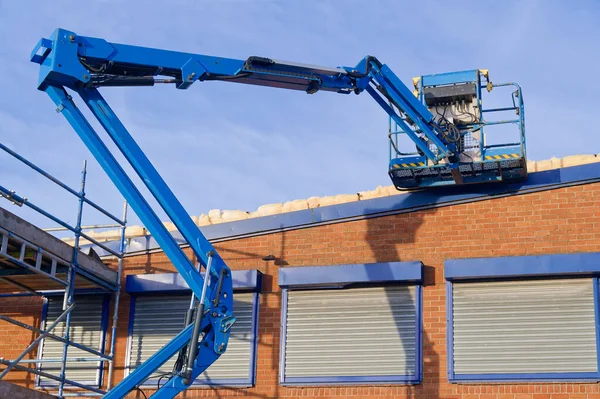
An articulating boom crane is a hydraulic lifting machine built with multiple folding joints, often called a knuckle boom crane, that bends and extends much like a human arm. This design gives operators far greater maneuverability than a straight telescopic boom in tight job sites, forestry lots, or dockyards. Payload capacities on these machines range from roughly 500 kilograms on light-duty truck mounts to more than 20,000 kilograms on heavy industrial units. Because of that lifting power, most jurisdictions in the United States require formal certification before you operate one commercially, and the training cost typically falls between $200 and $1,500 depending on your state and provider.
An articulating boom crane uses multiple hinged sections to bend and reach around obstacles, unlike a straight telescopic boom that only extends in one line. That folding arm design lets operators load and unload materials in tight yards, near power lines, or on uneven ground where a standard crane can’t get close enough. Construction crews, utility companies, and delivery fleets use them because the extra joints mean fewer repositioning moves and less time spent on each job. Prices and training requirements vary widely depending on lift capacity and reach, so knowing what drives those numbers matters before you sign a lease or send someone to certification classes.
Key Takeaways
- An articulating boom crane uses hydraulic knuckle joints to fold, extend, and rotate, unlike the sliding sections of a telescopic boom.
- Payload capacities span from about 500 kg for light-duty models to 30,000 kg for heavy-duty units.
- Major manufacturers include Hiab, Fassi, Palfinger, and Cargotec.
- Certification is required under Occupational Safety and Health Administration (OSHA) standards for lifting personnel and for loads over 2,000 lbs (907 kg), governed largely by 29 CFR 1926.1400.
- Certification programs cost between $200 and $1,500 in the United States, with the National Commission for the Certification of Crane Operators (NCCCO) Articulating Crane Certification the most recognized credential.
- Operating without certification can trigger OSHA fines up to $14,502 per violation under 2024 penalty schedules.
What Is an Articulating Boom Crane and How Does It Work?
An articulating boom crane relies on a series of hydraulic cylinders positioned at each joint of the boom, allowing the arm to bend, fold, and extend in segments rather than sliding out in one straight line. Operators control these joints individually, or through a coordinated hydraulic system, to position a load with precision even when obstacles block a direct approach. This is why the machine is often nicknamed a “knuckle boom crane,” a term that describes the way each section pivots like a knuckle in a human finger.
The hydraulic system typically runs off a power take-off connected to the truck engine or a standalone diesel or electric pump on stationary units. Pressure sensors and load-moment indicators monitor the strain on each joint in real time, which helps prevent overloading. The tradeoff for this flexibility is horizontal reach, since articulating booms generally cover less lateral distance than telescopic booms of comparable size.
Key Features That Define an Articulating Boom Crane
Several design elements separate articulating boom cranes from other lifting equipment on the market. Understanding these features helps you evaluate which model fits a specific job.
- Hydraulic articulated joints: Multiple pivot points allow the boom to fold into a compact Z-shape or unfold into an extended reach configuration.
- Compact storage profile: When not in use, the boom folds back against the truck chassis, reducing the transport length significantly compared to a fixed or telescopic arm.
- 360-degree rotation: Most models rotate the full circle around their base, letting operators reposition loads without repositioning the vehicle.
- Remote control operation: Many newer units include wireless remote controls, which let the operator stand at a safe distance and get a clearer view of the load path.
- Payload capacity range: Depending on the model, capacities run from around 500 kg on compact truck-mounted units to more than 20,000 kg on heavy industrial cranes.
What Industries Use Articulating Boom Cranes?
Articulating boom cranes handle material movement in settings where space is limited or where the load path is irregular. The following industries rely on them heavily:
- Construction: Placing roofing materials, HVAC units, and structural components on buildings where a straight boom cannot clear obstructions.
- Forestry: Loading and unloading logs onto transport trucks, often paired with grapple attachments.
- Utilities: Setting utility poles and performing maintenance on power lines from a bucket truck configuration.
- Marine operations: Loading and unloading cargo at docks where deck space and clearance are restricted.
- Waste management: Handling scrap metal and recyclable materials at processing facilities, where the crane must maneuver around bins and containers.
Articulating Boom Crane vs. Telescopic Boom Crane: What Is the Difference?
The core difference comes down to boom structure. An articulating boom uses multiple hinged sections, while a telescopic boom uses sliding sections that extend outward in a straight line. That structural difference changes how each crane performs on the job.
| Feature | Articulating Boom Crane | Telescopic Boom Crane |
| Boom Structure | Multiple hinged joints (knuckle boom) | Sliding sections, straight line extension |
| Flexibility | High maneuverability around obstacles | Limited articulation, mostly straight reach |
| Reach | Shorter horizontal reach | Extended horizontal and vertical reach |
| Transport Profile | Folds compactly, shorter transport length | Longer profile, less compact |
| Best Use Case | Tight spaces, precise positioning | High elevation lifts, long-distance reach |
If your work requires threading a load between buildings, trees, or overhead lines, an articulating boom generally performs better. If the job calls for reaching high or far without much obstruction, a telescopic boom often gets the load there faster.
Which Manufacturers Build Articulating Boom Cranes?
A handful of manufacturers dominate the global market for knuckle boom cranes, each with a slightly different specialty.
- Hiab: A leading name in truck-mounted articulating cranes, with a wide lineup covering light-duty to heavy industrial use.
- Fassi: Known for highly customizable knuckle boom models used across construction and forestry.
- Palfinger: Specializes in heavy-duty articulating cranes built for demanding industrial and municipal applications.
- Cargotec: A global supplier of lifting solutions, including articulating cranes for marine and cargo handling operations.
What Weight Can an Articulating Boom Crane Lift?
Lifting capacity depends heavily on the model class and boom extension length. As a general reference point across the market:
- Light-duty models: 500 kg to 3,000 kg, common on service trucks and utility vehicles.
- Medium-duty models: 3,000 kg to 10,000 kg, common in general construction and forestry work.
- Heavy-duty models: 10,000 kg to 30,000 kg, used in industrial, marine, and large-scale material handling operations.
Keep in mind that stated maximum capacity almost always applies at minimum boom extension. As the boom reaches further out, the safe working load drops, sometimes by more than half at full extension. Always check the load chart specific to your model before planning a lift near its rated maximum.
Do You Need Certification to Operate an Articulating Boom Crane?
Yes, you need certification to legally operate an articulating boom crane in most regions of the United States, though the exact requirement depends on the crane’s load capacity and how it is used. Federal regulation under 29 CFR 1926.1400 sets the baseline for crane operator qualification on construction sites, and OSHA treats articulating cranes used for lifting personnel or loads exceeding 2,000 lbs (907 kg) as requiring formal certification in nearly all cases.
| Crane Use Case | Certification Requirement |
| Lifting personnel with an articulating boom crane | Always required, no exceptions |
| Lifting loads over 2,000 lbs (907 kg) | Required in most cases under OSHA standards |
| Light-duty lifting under 2,000 lbs (907 kg) | Certification may not be mandatory, but training is strongly advised |
Certification Authorities by Region
| Region | Governing Authority | Certification Type |
| United States | OSHA / NCCCO | Articulating Crane Certification (ABC) |
| Canada | CCOHS | Provincial Crane Operator License |
| United Kingdom | CPCS | A66 Lorry Loader (Knuckle Boom) |
| Australia | WorkSafe / SafeWork | High-Risk Work Licence, CV Class |
How Do You Get Certified? A Step-by-Step Breakdown
The certification path is fairly consistent across accredited providers, though timelines and costs shift depending on the state and program you choose.
- Step 1: Enroll in an accredited training course. Programs typically run 1 to 5 days, with tuition ranging from $200 for a basic refresher to $1,500 for a full NCCCO-track course.
- Step 2: Complete the written examination. This exam covers safety protocols, load charts, hydraulic system components, and site setup procedures, and generally requires a passing score of 70 percent or higher.
- Step 3: Complete the practical skills test. You demonstrate load positioning, boom control, and safe shutdown procedures under the observation of a certified evaluator.
- Step 4: Receive your certification card. Most certifications remain valid for five years before requiring renewal, though some provincial and international licenses in Canada and Australia use three-year cycles.
What Happens If You Operate Without Certification?
Skipping certification is not a minor paperwork issue. OSHA enforcement carries direct financial and legal consequences for both operators and employers.
| Violation | Potential Penalty |
| Operating without certification (OSHA violation) | Fines up to $14,502 per violation, based on 2024 rates |
| Accident or injury involving an uncertified operator | Lawsuits, criminal charges, and operator suspension |
| Employer non-compliance | Higher fines, worksite shutdowns, and additional legal exposure |
Repeated or willful violations can push OSHA fines well beyond the standard cap, and a documented pattern of non-compliance often leads to increased inspection frequency at that company’s other job sites.
Are There Any Exemptions?
A few narrow exemptions exist within OSHA’s crane certification rules. Agricultural operations are often exempt from the standard certification requirement in roughly 20 to 25 states, though rules vary by state and by the type of lift being performed. Non-construction lifting tasks involving loads under 2,000 lbs (907 kg) may also fall outside the mandatory certification requirement, but most safety professionals still recommend formal training even when it is not legally required, since insurance carriers frequently ask for proof of training after any workplace incident.
Articulating Boom Crane Certification Pricing Breakdown
You typically spend between $200 and $1,500 to obtain an articulating boom crane certification in the United States, with the final number shaped by your location, the training provider, and the certification track you choose.
What Drives the Cost Up or Down?
| Cost Factor | Impact on Price |
| Training provider | Private training companies charge more than union-sponsored programs, sometimes by $300 to $500 |
| Certification type | NCCCO (US) or HRWL (Australia) tracks cost more than a basic in-house training certificate |
| Course length | 3 to 5 day comprehensive programs cost more than 1-day refresher courses |
| Practical testing fees | Hands-on exams add cost separately unless bundled into the base tuition |
| Retest fees | Retaking a written or practical exam typically costs $50 to $200 extra |
Certification Cost by Country
| Country | Estimated Cost Range (USD) | Primary Certification |
| United States | $1,000 to $1,500 | NCCCO Articulating Crane Operator Certification |
| Canada | $500 to $1,200 | Provincial Crane Operator License |
| United Kingdom | $600 to $1,200 (£500 to £1,000) | CPCS A66 Lorry Loader |
| Australia | $260 to $520 (AUD $400 to $800) | High-Risk Work Licence, CV Class |
Certification pricing in the United States tends to sit at the higher end of the global range, largely because the NCCCO credential involves both a written and practical exam administered by a third-party evaluator rather than the training provider itself.
Additional Costs to Budget For
- Study materials: $50 to $150 for load charts, manuals, and safety handbooks.
- Travel expenses: Training centers located outside your immediate area may require travel or overnight lodging costs.
- Renewal fees: Recertification every three to five years typically runs $100 to $300.
Some employers cover part or all of these certification costs as part of a broader safety training budget, particularly in construction, utilities, and freight transport, where crane operation is a routine job function rather than an occasional task.
Conclusion
An articulating boom crane offers a level of maneuverability that a straight telescopic boom simply cannot match, which is why construction crews, utility companies, forestry operations, and marine terminals continue to rely on this equipment for close-quarters lifting. Choosing the right model comes down to matching payload capacity and reach to the actual job, whether that means a light-duty 500 kg truck mount or a 20,000 kg industrial unit. Before anyone steps into the operator seat, certification through a recognized program such as NCCCO in the United States protects the worker, the employer, and everyone on the surrounding job site. With training costs generally landing between $200 and $1,500, certification represents a modest investment against fines that can exceed $14,000 per OSHA violation, not to mention the far greater cost of a preventable accident.
Frequently Asked Questions
What is the main advantage of an articulating boom crane over a telescopic crane?
An articulating boom crane maneuvers around obstacles far more easily because its joints fold and bend rather than extend in a straight line. This makes it better suited for tight construction sites, dockyards, and forestry lots where a straight telescopic arm cannot reach around structures or trees.
How long does it take to get certified to operate an articulating boom crane?
Most certification programs take between one and five days to complete, depending on the course type. A basic refresher course can be finished in a single day, while a full NCCCO-track certification with written and practical exams typically spans three to five days.
Is certification required for every size of articulating boom crane?
No, certification requirements depend on load capacity and whether personnel are being lifted. Loads over 2,000 lbs (907 kg) generally require certification under OSHA standards, while lighter-duty lifts may only require training rather than formal certification, though training is still strongly recommended.
How much does NCCCO certification cost in the United States?
NCCCO Articulating Crane Operator Certification typically costs between $1,000 and $1,500. The price depends on the training provider, whether practical testing is bundled into the course fee, and whether you need to travel to a testing location.
How often do you need to renew an articulating boom crane certification?
Certification is generally valid for five years before renewal is required, though some regions use a three-year cycle. Renewal fees usually run between $100 and $300, and some providers require a short refresher course before reissuing the credential.